







Question: A cylindrical metal specimen 12.7 mm (0.5 in.) in diameter and 250 mm (10 in.) long is to be subjected to a tensile stress of
A cylindrical metal specimen 12.7 mm (0.5 in.) in diameter and 250 mm (10 in.) long is to be subjected to a tensile stress of 28MPa (4000 psi); at this stress level the resulting deformation will be totally elastic.
(a)?If the elongation must be less than 0.080 mm (3.2 ? 10-3 in.), which of the metals in Table 6.1 are suitable candidates? Why?
(b)?If, in addition, the maximum permissible diameter decrease is 1.2 ? 10-3 mm (4.7 ? 10-5 in.) when the tensile stress of 28MPa is applied, which of the metals that satisfy the criterion in part (a) are suitable candidates? Why?
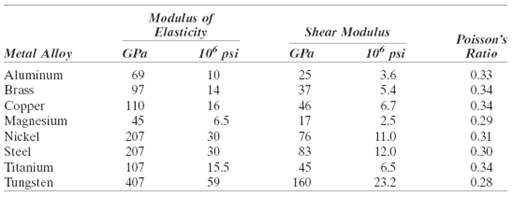
Modulus of Shear Modulus Elasticity 10 psi Poisson's Ratio GPa 25 37 46 10 psi 3.6 5.4 6.7 2.5 11.0 Metal Alloy GPa Aluminum Brass 69 10 14 16 6.5 0.33 97 110 45 207 207 107 407 0.34 Copper Magnesium Nickel Steel 0.34 17 76 83 45 160 0.29 0.31 30 12.0 6.5 23.2 0.34 Titanium 15.5 59 Tungsten 0.28
Step by Step Solution
3.30 Rating (162 Votes )
There are 3 Steps involved in it
a This part of the problem asks that we ascertain which of the metals in Table 61 experience an elongation of less than 0080 mm when subjected to a te... View full answer

Get step-by-step solutions from verified subject matter experts
Document Format (1 attachment)

33-E-M-S-E-M-S (183).docx
120 KBs Word File
 Study Help