



Question: A precipitation process for producing perfect spheres of silica has been developed. The individual particles are so small that most cannot be discerned by the
A precipitation process for producing perfect spheres of silica has been developed. The individual particles are so small that most cannot be discerned by the naked eye. Using optical microscopy, the particle size distribution has been measured, with results given in the table below. Using these data on a spreadsheet program:
Determine:
(1) surface-mean diameter
(2) arithmetic-mean diameter
(3) mass-mean diameter
(4) volume-meandiameter
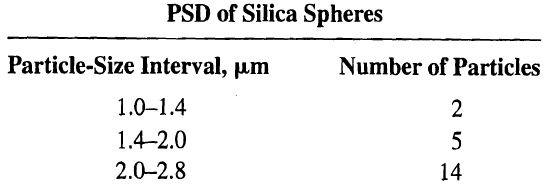
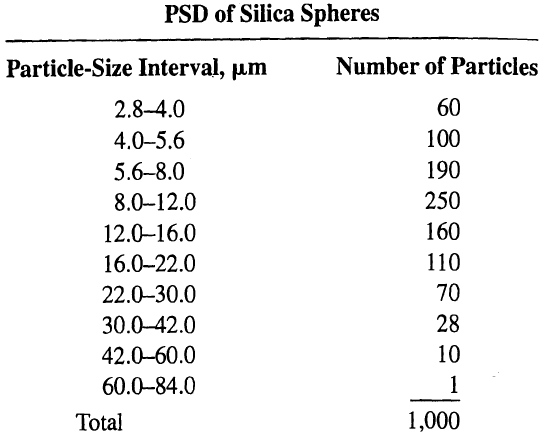
PSD of Silica Spheres Particle-Size Interval, m Number of Particles 1.0-1.4 1.4-2.0 2.0-2.8 5 14
Step by Step Solution
3.40 Rating (178 Votes )
There are 3 Steps involved in it
Use a spreadsheet to do the calculations and prepare the plots The equations for Part Are as ... View full answer

Get step-by-step solutions from verified subject matter experts
Document Format (1 attachment)

37-E-C-E-S-P (570).docx
120 KBs Word File