







Question: As noted in Prob. 1.3, drag is more accurately represented as depending on the square of velocity. A more fundamental representation of the drag force,
As noted in Prob. 1.3, drag is more accurately represented as depending on the square of velocity. A more fundamental representation of the drag force, which assumes turbulent conditions (i.e., a high Reynolds number), can be formulated as
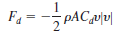
where Fd = the drag force (N), r = fluid density (kg/m3), A = the frontal area of the object on a plane perpendicular to the direction of motion (m2), ν = velocity (m/s), and Cd = a dimensionless drag coefficient.
(a) Write the pair of differential equations for velocity and position (see Prob. 1.18) to describe the vertical motion of a sphere with diameter d (m) and a density of ps (kg/km3). The differential equation for velocity should be written as a function of the sphere’s diameter.
(b) Use Euler’s method with a step size of Δt = 2 s to compute the position and velocity of a sphere over the first 14 s. Employ the following parameters in your calculation: d = 120 cm, p = 1.3 kg/m3, ps = 2700 kg/m3, and Cd = 0.47. Assume that the sphere has the initial conditions: x(0) = 100 m and ν(0) = –40 m/s.
(c) Develop a plot of your results (i.e., y and ν versus t) and use it to graphically estimate when the sphere would hit the ground.
(d) Compute the value for the bulk second-order drag coefficient Cd’ (kg/m). Note that, as described in Prob. 1.3, the bulk second order drag coefficient is the term in the final differential equation for velocity that multiplies the term ν | ν |.
1 pACvjv| F4 PACartul
Step by Step Solution
3.47 Rating (177 Votes )
There are 3 Steps involved in it
a The force balance can be written as Dividing by mass gives The mas... View full answer

Get step-by-step solutions from verified subject matter experts
Document Format (1 attachment)

1228-M-N-A-O(827).docx
120 KBs Word File
 Study Help