







Question: Consider the following program: Note that the scheduler in a uniprocessor system would implement pseudo parallel execution of these two concurrent processes by interleaving their
Consider the following program:
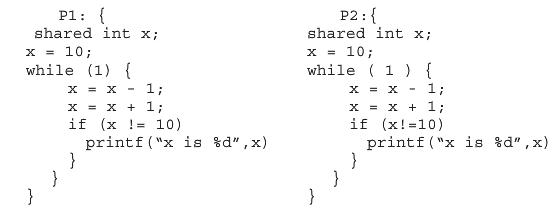
Note that the scheduler in a uniprocessor system would implement pseudo parallel execution of these two concurrent processes by interleaving their instructions, without restriction on the order of the interleaving.
a. Show a sequence (i.e., trace the sequence of inter-leavings of statements) such that the statement “x is 10” is printed.
b. Show a sequence such that the statement “x is 8” is printed. You should remember that the increment/decrements at the source language level are not done atomically, that is, the assembly language code:

Implements the single C increment instruction (x = x + 1).
P1: P2: shared int x; x = 10; shared int x; x=10; while 1 while (1) ( x=x-1; x=x+1; if (x != 10) x=x-1; x=x+1; if (x ! =10) printf("x is %d",x) printf ("X 18 %d", x) LD RO, x load RO from memory location x */ INCR RO* STO R0,X /*store the incremented value back in X */ increment RO /
Step by Step Solution
3.29 Rating (164 Votes )
There are 3 Steps involved in it
a For x is 10 the interleaving producing the required behavior is easy to find since it requires onl... View full answer

Get step-by-step solutions from verified subject matter experts
Document Format (1 attachment)

451-C-S-D-B-O-S (65).docx
120 KBs Word File
 Study Help