



Question: Figure shows the cascade connection of a linear channel and a synchronous tapped delay-line equalizer. The impulse response of the channel is denoted by c
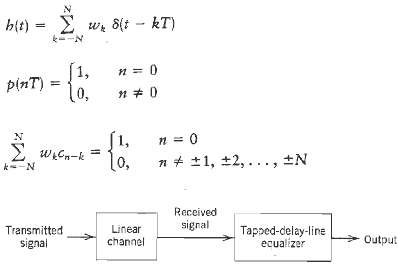
Figure shows the cascade connection of a linear channel and a synchronous tapped delay-line equalizer. The impulse response of the channel is denoted by c (t), and that of the equalizer is denoted by h (t). The h (t) is defined by, where T is the spacing between adjacent taps of the equalizer, and the wk are its tap- weights (coefficients). The impulse response of the cascaded system of Figure is denoted by p (t). The p (t) is sampled uniformly at the rate 1/T. To eliminate inter symbol interference, we require that the Nyquist criterion for distortion less transmission be satisfied, as shown by
(a) By imposing this condition, show that the (2N + 1) tap-weights of the resulting zero forcing equalizer satisfy the following set of (2N + 1) simultaneous equations, where cn = c (n T). Hence, show that the zero-forcing equalizer is an inverse filter in that its transfer function is equal to the reciprocal of the transfer function of dc channel.
(b) A shortcoming of the zero-forcing equalizer is noise enhancement that cans result in poor performance in the presence of channel noise. To explore this phenomenon, consider a low-pass channel with a notch at the Nyquist frequency, that is, H (?) is zero at ? = 1/2T. Assuming that the channel noise is additive and white, show that the power spectral density of the noise at the equalizer output approaches infinity at ? = 1/2T. Even if the channel has no notch in its frequency response, the power spectral density of the noise at the equalizer output can assume high values. Justify the validity of this general statement.
E wz 8(t - kT) k--N b(t) [1, p(nT) to, (0, [1, lo, WCN-k n+ 1, 2,..., N Received signal Transmitted signal Linear channel Tapped-delay-line ecualizer Output
Step by Step Solution
3.28 Rating (169 Votes )
There are 3 Steps involved in it
a Input Channel The h is defined by Equalizer h1 Output N ht w81kT kN The impulse response of the ca... View full answer

Get step-by-step solutions from verified subject matter experts
Document Format (1 attachment)

19-E-T-E-C-S (314).docx
120 KBs Word File