







Question: In any absorption operation, the absorbent is stripped to some extent depending on the K-value of the absorbent. In any stripping operation, the stripping agent
In any absorption operation, the absorbent is stripped to some extent depending on the K-value of the absorbent. In any stripping operation, the stripping agent is absorbed to some extent depending on its K-value. In Figur, it is seen that both absorption and stripping occur. Which occurs to the greatest extent in terms of kilomoles per hour? Should the operation be called an absorber or a stripper?Why?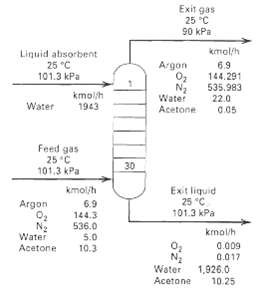
Exit gas 25 C 90 kPa kmol/h Liguid absorbent 25 C 101.3 kPa Argon 6.9 144.291 535.983 N2 Water Acetone kmolh 22.0 Water 1943 0.05 Feed gas 25 "C 101.3 kPa 30 kmol/h Exit liquid 25 "C 101.3 kPa Argon 6.9 144.3 536.0 5.0 10.3 Ng Water kmol/h 0.009 Acetone N2 1,926.0 10.25 0.017 Water Acetane
Step by Step Solution
3.46 Rating (182 Votes )
There are 3 Steps involved in it
Stripping of water 22 kmolh Absorption of acetone 1035 ... View full answer

Get step-by-step solutions from verified subject matter experts
Document Format (1 attachment)

37-E-C-E-S-P (206).docx
120 KBs Word File
 Study Help