







Question: In Figure two isotropic point sources S1 and S2 emit light in phase at wavelength A and at the same amplitude. The sources are separated
In Figure two isotropic point sources S1 and S2 emit light in phase at wavelength A and at the same amplitude. The sources are separated by distance 2d = 6.00λ. They lie on an axis that is parallel to an x axis, which runs along a viewing screen at distance D = 20.0λ. The origin lies on the perpendicular bisector between the sources. The figure shows two rays reaching point P on the screen, at position xp.
(a) At what value of xp do the rays have the minimum possible phase difference?
(b) What multiple of λ gives that minimum phase difference?
(c) At what value of xp do the rays have the maximum possible phase difference? What multiple of λ gives?
(d) That maximum phase difference and
(e) The phase difference when xp = 6.00λ?
(f) When xp = 6.00.tr, is the resulting intensity at point P maximum, minimum, intermediate but closer to maximum, or intermediate but closer to minimum?
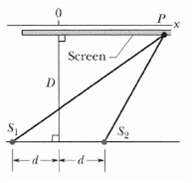
Screen
Step by Step Solution
3.30 Rating (174 Votes )
There are 3 Steps involved in it
a We note that just as in the usual discussion of the double slit pattern the x 0 point on the scree... View full answer

Get step-by-step solutions from verified subject matter experts
Document Format (1 attachment)

2-P-L-I-L (205).docx
120 KBs Word File
 Study Help