







Question: In this problem we address the uplink power budget of the digital satellite communication system considered in Example 8.2. The parameters of the link are
In this problem we address the uplink power budget of the digital satellite communication system considered in Example 8.2. The parameters of the link are as follows:
Carrier frequency? ? ? ? ? ? ? ? ? ? ? ? ? ? ? ? ? ? ? ? ? ? ? ? ? ? ? ? ? ? ? ? ? ? ? ? ? ? ? ? ? ? ? ? ?= 14 GHz
Power density at the TWT amplifier in saturation? ? ? ? ? ? ? ? ? ? ? ? ? ? ? ? ? = ? 81dbW/m2
Satellite figure of merit, G/T? ? ? ? ? ? ? ? ? ? ? ? ? ? ? ? ? ? ? ? ? ? ? ? ? ? ? ? ? ? ? ? ? ? ? ?= 1.9 dB/K
Distance of the satellite from the transmitting earth terminal ? ? ? ? ? ?= 40,000 km
(a) Assuming no power back off of the TWT, calculate the C/N0 ratio at the satellite.
(b) Given that the data rate in the uplink is the same as that calculated for the downlink in Example 8.2, calculate the probability of symbol error incurred in the uplink allowing for a link margin of 6 dB. Compare your result with that in Example 8.2.
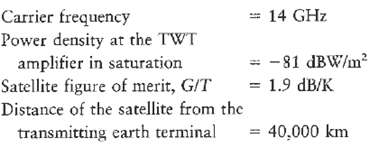
Carrier frequency Power density at the TWT amplifier in saturation Satellite figure of merit, G/T Distance of the satellite from the transmitting earth terminal = 14 GHz = -81 dBW/m 1.9 dB/K = 40,000 km
Step by Step Solution
3.34 Rating (175 Votes )
There are 3 Steps involved in it
a For the uplink power budget the ratio is given by CIN Nuplink where 7749 9 G BO G T 0 G BO k L k P... View full answer

Get step-by-step solutions from verified subject matter experts
Document Format (1 attachment)

19-E-T-E-C-S (107).docx
120 KBs Word File
 Study Help