







Question: Isopropyl alcohol is undergoing mass transfer at 35?C and 2 atm under dilute conditions through water, across a phase boundary, and then through nitrogen. Based
Isopropyl alcohol is undergoing mass transfer at 35?C and 2 atm under dilute conditions through water, across a phase boundary, and then through nitrogen. Based on the date given below, estimate for isopropyl alcohol:
(a) The diffusivity in water using the Wilke-Chang equation
(b) The diffusivity in nitrogen using the Fuller et al. equation
(c) The product, DABpM,in water
(d) The product, DABpM,in air where pM is the molar density of the mixture. Using the above results, compare:
(e) The diffusivities in parts (a) and (b)
(f) The diffusivity-molar density products in Parts (c) and (d) Lastly:
(g) What conclusions can you come to about molecular diffusion in the liquid phase versus the gaseous phase?Data:
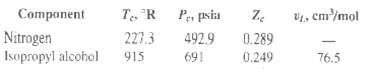
T, R Pe psia Component V1, em'/mol Ze 0.289 0.249 227.3 492.9 Nitrogen Isopropyl alcohol 691 76.5 915
Step by Step Solution
3.44 Rating (179 Votes )
There are 3 Steps involved in it
a For the WilkeChang equation 339 use B 26 and M B 18 From Perrys Handbook B 078 cP Fr... View full answer

Get step-by-step solutions from verified subject matter experts
Document Format (1 attachment)

37-E-C-E-S-P (64).docx
120 KBs Word File
 Study Help