







Question: Radial flow between parallel disks (Fig. 3B.10). A part of a lubrication system consists of two circular disks between which a lubricant flows radially. The
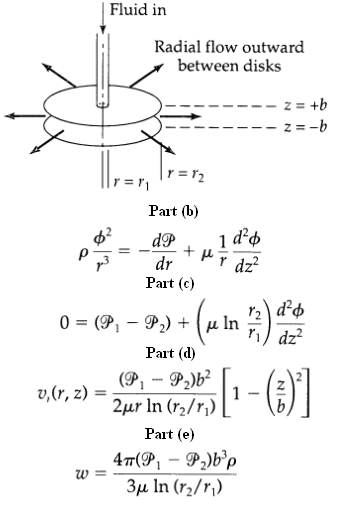
Radial flow between parallel disks (Fig. 3B.10). A part of a lubrication system consists of two circular disks between which a lubricant flows radially. The flow takes place because of a modified pressure difference P1 – P2 between the inner and outer radii r1 and r2, respectively.
(a) Write the equations of continuity and motion for this flow system, assuming steady-state, laminar, incompressible Newtonian flow. Consider only the region r1 < r < r2 and a flow that is radially directed. Fig. 3B.10 outward radial flow in the space between two parallel, circular disks
(b) Show how the equation of continuity enables one to simplify the equation of motion to give in which Ф = rv, is a function of z only. Why is Ф independent of r?
(c) It can be shown that no solution exists for Eq. 3B.10-1 unless the nonlinear term containing & is omitted. Omission of this term corresponds to the "creeping flow assumption." Show that for creeping flow, Eq. 3B.10-1 can be integrated with respect to r to give
(d) Show that further integration with respect to z gives
(e) Show that the mass flow rate is
Fluid in Radial flow outward between disks z = +b z = -b r = r2 Part (b) 1 do dz? dP dr Part (c) r2) do dz? 0 = (P, P2) + (u In Part (d) (P, - P2)b? 2r In (r2/r,) v,(r, z) = Part (e) 47(P, - P2)bp 3 In (r2/r,)
Step by Step Solution
3.52 Rating (155 Votes )
There are 3 Steps involved in it
Radial flow between parallel disks a The continuity equation is for v v rz from Eq B42 1 a rv 0 rr r... View full answer

Get step-by-step solutions from verified subject matter experts
Document Format (1 attachment)

6-E-C-E-T-P (57).docx
120 KBs Word File
 Study Help