







Question: Consider the network shown in Figure 14.22 (ii), and assume that the two telescopes work identically. N {1, 2, 3} and M 1 , M
Consider the network shown in Figure 14.22 (ii), and assume that the two telescopes work identically. N ˆˆ{1, 2, 3} and M1, M2ˆˆ{0, 1, 2, 3, 4}, with the symbolic CPTs as described in Exercise 14.12. Using the enumeration algorithm (Figure 14.9 on page 525), calculate the probability distribution P(N |M1=2, M2=2).
Figure 14.9
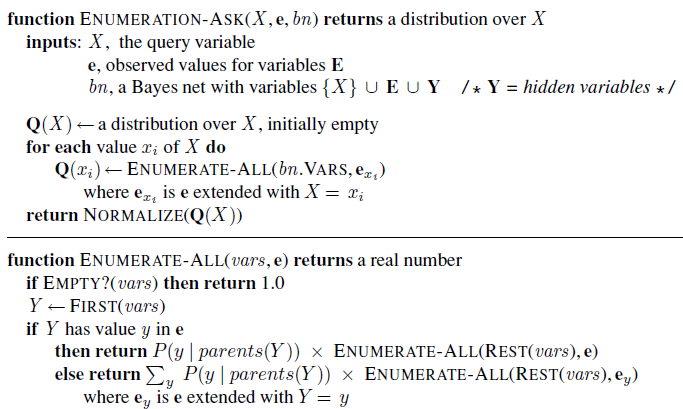
function ENUMERATION-ASK(X, e, bn) returns a distribution over X inputs: X, the query variable e, observed values for variables E bn, a Bayes net with variables {X} UEUY /* Y = hidden variables * / Q(X)-a distribution over X, initially empty for each value x; of X do Q(x;) - ENUMERATE-ALL(bn.VARS, er,) where e, is e extended with X = x; return NORMALIZE(Q(X)) function ENUMERATE-ALL(vars, e) returns a real number if EMPTY?(vars) then return 1.0 Y - FIRST(vars) if Y has value y in e then return P(y | parents(Y)) ENUMERATE-ALL(REST(vars), e) else return E, P(y|parents(Y)) ENUMERATE-ALL(REST(vars), e,) where e, is e extended with Y = y
Step by Step Solution
3.31 Rating (169 Votes )
There are 3 Steps involved in it
The symbolic expression evaluated by the enumeration algorit... View full answer

Get step-by-step solutions from verified subject matter experts
 Study Help