







Question: Pick one of the application areas for agent architectures summarized in Section 7.4. Choose a research or application paper in that area. Design an organization
Pick one of the application areas for agent architectures summarized in Section 7.4. Choose a research or application paper in that area. Design an organization of agents that could address the problem. Break the problem down to specify issues of responsibility for each agent. List appropriate cooperation procedures.
Data from section 7.4
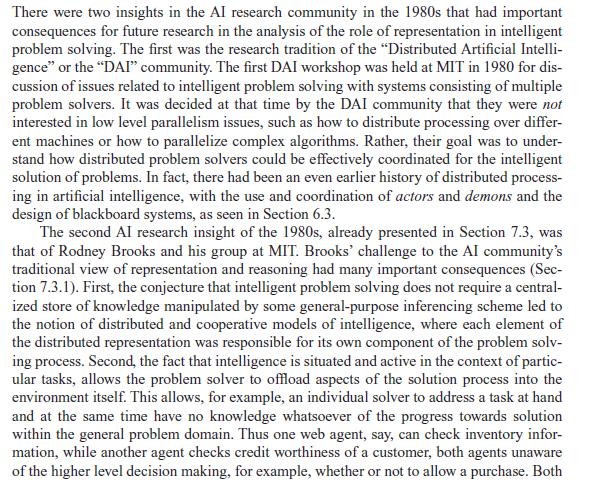

There were two insights in the AI research community in the 1980s that had important consequences for future research in the analysis of the role of representation in intelligent problem solving. The first was the research tradition of the "Distributed Artificial Intelli- gence" or the "DAI" community. The first DAI workshop was held at MIT in 1980 for dis- cussion of issues related to intelligent problem solving with systems consisting of multiple problem solvers. It was decided at that time by the DAI community that they were not interested in low level parallelism issues, such as how to distribute processing over differ- ent machines or how to parallelize complex algorithms. Rather, their goal was to under- stand how distributed problem solvers could be effectively coordinated for the intelligent solution of problems. In fact, there had been an even earlier history of distributed process- ing in artificial intelligence, with the use and coordination of actors and demons and the design of blackboard systems, as seen in Section 6.3. The second AI research insight of the 1980s, already presented in Section 7.3, was that of Rodney Brooks and his group at MIT. Brooks' challenge to the AI community's traditional view of representation and reasoning had many important consequences (Sec- tion 7.3.1). First, the conjecture that intelligent problem solving does not require a central- ized store of knowledge manipulated by some general-purpose inferencing scheme led to the notion of distributed and cooperative models of intelligence, where each element of the distributed representation was responsible for its own component of the problem solv- ing process. Second, the fact that intelligence is situated and active in the context of partic- ular tasks, allows the problem solver to offload aspects of the solution process into the environment itself. This allows, for example, an individual solver to address a task at hand and at the same time have no knowledge whatsoever of the progress towards solution within the general problem domain. Thus one web agent, say, can check inventory infor- mation, while another agent checks credit worthiness of a customer, both agents unaware of the higher level decision making, for example, whether or not to allow a purchase. Both
Step by Step Solution
3.36 Rating (152 Votes )
There are 3 Steps involved in it
Given the information from the provided text and without access to the full context of Section 74 I can still outline a general approach on how to design an organization of agents based on the Distrib... View full answer

Get step-by-step solutions from verified subject matter experts
 Study Help