







Question: Let y it = 1 or 0 for observation t on subject i, i = 1,..., n, t = 1, ..., T. Let y .t
Let yit = 1 or 0 for observation t on subject i, i = 1,..., n, t = 1, ..., T. Let y.t = ?i yit/n, yi. = ?t yit/T, and y.. = ?i ?t yit/nT.
a. Regard {yi+} as fixed. Suppose that each way to allocate the yi+ ?successes? to yi+ of the observations is equally likely. Show that E(Yit) = yi, var(Yit) = yi.(1 ? yi), and cov(Yit, Yik) = ? yi.(1 ? yi.)/(T ? 1) for t ? k. [The covariance is the same for any pair of cells in the same row, and var(?t Yit) = 0 since yi+ is fixed.]
b. Refer to part (a). For large n with independent subjects, explain why (Y.1,..., Y.T) is approximately multivariate normal with pairwise correlation ? = ?1/(T ? 1). Conclude that Cochran?s Q statistic (Cochran 1950)
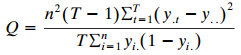
is approximately chi-squared with df = (T ? 1). [One way notes that if (X1,..., XT) is multivariate normal with common mean and common variance ?2 and common correlation ? for pairs (Xt, Xk), then ?(Xt ? X?)2/?2(1 ? ?) is chi-squared with df = (T ? 1). See Bhapkar and Somes (1977) for slightly weaker conditions for a chi-squared limiting distribution for Q than those in part (a).]
c. Show that Q is unaffected by deleting cases in which yi1 = ... = yiT.
n? (T - 1) (y - y.)' .(1- y )
Step by Step Solution
3.38 Rating (157 Votes )
There are 3 Steps involved in it
a EYit yi This is because the expected value of a Bernoulli random variable is equal to its probabil... View full answer

Get step-by-step solutions from verified subject matter experts
 Study Help