







Question: Using a negative step tracer input, Cholette and Cloutier (Can. J. Chem. Eng., 37, 107 (1959)) studied the RTD in a tank for different stirring
Using a negative step tracer input, Cholette and Cloutier (Can. J. Chem. Eng., 37, 107 (1959)) studied the RTD in a tank for different stirring speeds. Their tank had a 30-in. diameter and a fluid depth of 30 in. indide the tank. The inlet and exit flow rates were 1.15 gal/min. Here are some of their tracer results for the relative concentration, C/C0 (courtesy of the Canadian Society for Chemical Engineering):
NEGATIVE STEPS TRACER TEST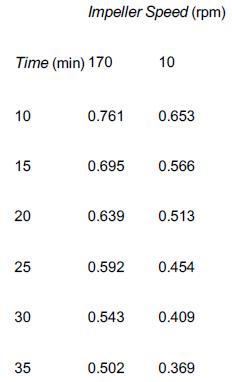
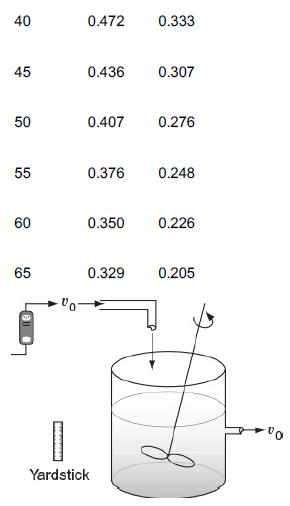
The CSTR tank with a stirrer that rotates counter-clockwise is shown. The negative step tracer input with flow rate v Subscript 0 is fed to the CSTR tank. The outlet from the tank has a resultant flow rate of v Subscript 0. The yardstick used in measuring is also shown. Calculate and plot the cumulative exit-age distribution, the intensity function, and the internal-age distributions as a function of time for this stirred tank at the two impeller speeds. Can you tell anything about the dead zones and bypassing at the different stirrer rates?
Time (min) 170 10 15 20 25 30 Impeller Speed (rpm) 35 0.761 0.695 0.592 10 0.653 0.639 0.513 0.502 0.566 0.454 0.543 0.409 0.369
Step by Step Solution
3.50 Rating (157 Votes )
There are 3 Steps involved in it
Cumulative exit age distribution function Ft Etdt Ct 1 40 a dt1 dt Co Co For a negative step Ft I1 1... View full answer

Get step-by-step solutions from verified subject matter experts
 Study Help