







Question: Answer the following questions related to the FSMs for the Stop-and-Wait protocol (Figure 23.21): a. The sending machine is in the ready state and S
Answer the following questions related to the FSMs for the Stop-and-Wait protocol (Figure 23.21):
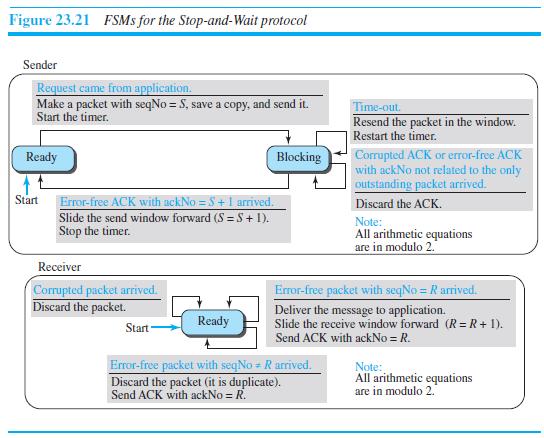
a. The sending machine is in the ready state and S = 0. What is the sequence number of the next packet to send?
b. The sending machine is in the blocking state and S = 1. What is the sequence number of the next packet to send if a time-out occurs?
c. The receiving machine is in the ready state and R = 1. A packet with the sequence number 1 arrives. What is the action in response to this event?
d. The receiving machine is in the ready state and R = 1. A packet with the sequence number 0 arrives. What is the action in response to this event?
Figure 23.21 FSMS for the Stop-and-Wait protocol Sender Request came from application. Make a packet with seqNo = S, save a copy, and send it. Start the timer. Time-out. Resend the packet in the window. Restart the timer. Corrupted ACK or error-free ACK with ackNo not related to the only outstanding packet arived. Ready Blocking Start Error-free ACK with ackNo = $ +1 arrived. Slide the send window forward (S = S+1). Stop the timer. Discard the ACK. Note: All arithmetic equations are in modulo 2." Receiver Corrupted packet arrived. Discard the packet. Error-free packet with seqNo = R arrived. Deliver the message to application. Slide the receive window forward (R= R + 1). Send ACK with ackNo = R. Ready Start Error-free packet with seqNo = Rarrived. Discard the packet (it is duplicate). Send ACK with ackNo = R. Note: All arithmetic equations are in modulo 2.
Step by Step Solution
3.39 Rating (165 Votes )
There are 3 Steps involved in it
We assume each event is independent a ... View full answer

Get step-by-step solutions from verified subject matter experts
 Study Help