







Question: How does the performance of restoring and non-restoring division compare? Demonstrate by showing the number of steps necessary to calculate A divided by B using
How does the performance of restoring and non-restoring division compare? Demonstrate by showing the number of steps necessary to calculate A divided by B using each method. Assume A and B are 6-bit signed (sign- magnitude) integers. Writing a program to perform the restoring and non restoring divisions is acceptable.
Figure 3.10 describes a restoring division algorithm, because when subtracting the divisor from the remainder produces a negative result, the divisor is added back to the remainder (thus restoring the value). However, there are other algorithms that have been developed that eliminate the extra addition. Many references to these algorithms are easily found on the web. We will explore these algorithms using the pairs of octal numbers in the following table.
Figure 3.10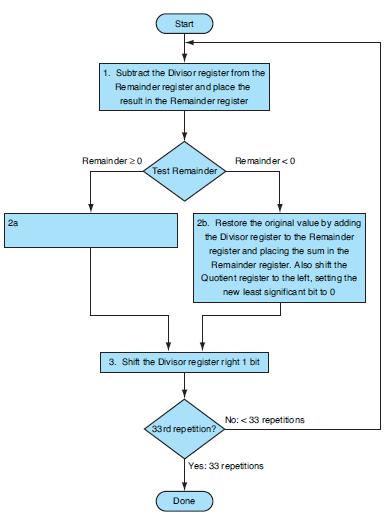

2a Start 1. Subtract the Divisor register from the Remainder register and place the result in the Remainder register Remainder 20 Test Remainder Remainder
Step by Step Solution
3.44 Rating (163 Votes )
There are 3 Steps involved in it
Using the provided signed 6bit integers A and B as a starting point B 5 000101 and A 26 001101 To find A B well employ both the restoring and nonresto... View full answer

Get step-by-step solutions from verified subject matter experts
 Study Help