







Question: The study cited in the article entitled Only the Timid Die Young stated that Timid rats were 60% more likely to die at any given
The study cited in the article entitled “Only the Timid Die Young” stated that “Timid rats were 60% more likely to die at any given time than were their outgoing brothers.” Based on the results, answer the following questions.
a. Why were rats used in the study?
b. What are the variables in the study?
c. Why were infants included in the article?
d. What is wrong with extrapolating the results to humans?
e. Suggest some ways humans might be used in a study of this type.
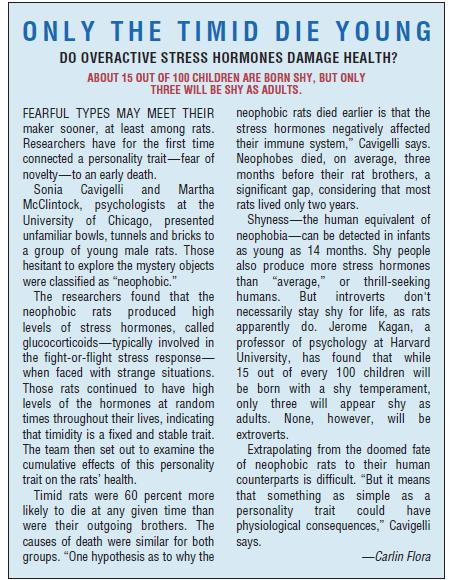
ONLY THE TIMID DIE YOUNG DO OVERACTIVE STRESS HORMONES DAMAGE HEALTH? ABOUT 15 OUT OF 100 CHILDREN ARE BORN SHY, BUT ONLY THREE WILL BE SHY AS ADULTS. FEARFUL TYPES MAY MEET THEIR maker sooner, at least among rats. Researchers have for the first time connected a personality trait-fear of novelty to an early death. Sonia Cavigelli and Martha McClintock, psychologists at the University of Chicago, presented unfamiliar bowls, tunnels and bricks to a group of young male rats. Those hesitant to explore the mystery objects were classified as "neophobic." The researchers found that the neophobic rats produced high levels of stress hormones, called glucocorticoids-typically involved in the fight-or-flight stress response- when faced with strange situations. Those rats continued to have high levels of the hormones at random times throughout their lives, indicating that timidity is a fixed and stable trait. The team then set out to examine the cumulative effects of this personality trait on the rats' health. Timid rats were 60 percent more likely to die at any given time than were their outgoing brothers. The causes of death were similar for both groups. "One hypothesis as to why the neophobic rats died earlier is that the stress hormones negatively affected their immune system," Cavigelli says. Neophobes died, on average, three months before their rat brothers, a significant gap, considering that most rats lived only two years. Shyness-the human equivalent of neophobia-can be detected in infants as young as 14 months. Shy people also produce more stress hormones than "average," or thrill-seeking humans. But introverts don't necessarily stay shy for life, as rats apparently do. Jerome Kagan, a professor of psychology at Harvard University, has found that while 15 out of every 100 children will be born with a shy temperament, only three will appear shy as adults. None, however, will be extroverts. Extrapolating from the doomed fate of neophobic rats to their human counterparts is difficult. "But it means that something as simple as a personality trait could have physiological consequences," Cavigelli says. --Carlin Flora
Step by Step Solution
3.57 Rating (161 Votes )
There are 3 Steps involved in it
Solution a It is because of their social behavior and their willingness to obs... View full answer

Get step-by-step solutions from verified subject matter experts
 Study Help