







Question: An electrostatic precipitator (ESP) is a device used in various applications to clean particle-laden air. First, the dusty air passes through the charging stage of
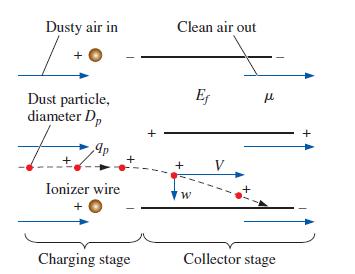
An electrostatic precipitator (ESP) is a device used in various applications to clean particle-laden air. First, the dusty air passes through the charging stage of the ESP, where dust particles are given a positive charge qp (coulombs) by charged ionizer wires (Fig. P7–111). The dusty air then enters the collector stage of the device, where it flows between two oppositely charged plates. The applied electric field strength between the plates is Ef (voltage difference per unit distance). Shown in Fig. P7–111 is a charged dust particle of diameter Dp. It is attracted to the negatively charged plate and moves toward that plate at a speed called the drift velocity w. If the plates are long enough, the dust particle impacts the negatively charged plate and adheres to it. Clean air exits the device. It turns out that for very small particles the drift velocity depends only on qp, Ef , Dp, and air viscosity μ.
(a) Generate a dimensionless relationship between the drift velocity through the collector stage of the ESP and the given parameters. Show all your work.
(b) If the electric field strength is doubled, all else being equal, by what factor will the drift velocity change?
(c) For a given ESP, if the particle diameter is doubled, all else being equal, by what factor will the drift velocity change?
FIGURE P7–111
Dusty air in + Dust particle, diameter Dp 9p to Ionizer wire Charging stage Clean air out W Ef l Collector stage
Step by Step Solution
3.37 Rating (156 Votes )
There are 3 Steps involved in it
a To generate a dimensionless relationship between the drift velocity w through the collector stage ... View full answer

Get step-by-step solutions from verified subject matter experts
 Study Help