







Question: Climate change 2016 Recent concern with the rise in global temperatures has focused attention on the level of carbon dioxide (CO2) in the atmosphere. The
Climate change 2016 Recent concern with the rise in global temperatures has focused attention on the level of carbon dioxide (CO2) in the atmosphere. The National Oceanic and Atmospheric Administration (NOAA) records the CO2 levels in the atmosphere atop the Mauna Loa volcano in Hawaii, far from any industrial contamination, and calculates the annual overall temperature of the atmosphere and the oceans using an established method. It is widely acknowledged that global average temperatures have been rising. A politician, arguing that human behavior is not responsible for the rise in temperatures, presents the following regression:
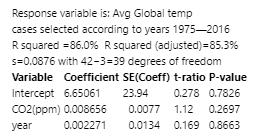
He argues that because the coefficient of CO2 has a large, non-significant P-value, we should conclude that there is no effect of rising CO2 levels.
You look at the data and find the following correlations:
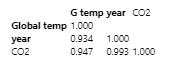
1. What do you think accounts for the small t-ratios in the regression when there clearly is an association between Average Global temperature and each of the predictors?
2. What data formatting operation was performed to focus on these years?
Response variable is: Avg Global temp cases selected according to years 1975-2016 R squared = 86.0% R squared (adjusted)=85.3% s=0.0876 with 42-3-39 degrees of freedom Variable Coefficient SE(Coeff) t-ratio P-value Intercept 6.65061 23.94 0.278 0.7826 CO2(ppm) 0.008656 0.0077 1.12 0.2697 year 0.002271 0.0134 0.169 0.8663
Step by Step Solution
3.44 Rating (167 Votes )
There are 3 Steps involved in it
1 CO 2 and Year are clearly collinear That will make the tratios ... View full answer

Get step-by-step solutions from verified subject matter experts
 Study Help