







Question: In 1843, Sir William Hamilton discovered an extension to complex numbers called quaternions. A quaternion is a 4-tuple (a=left(a_{0}, a_{1}, a_{2}, a_{3}ight)) with the following
In 1843, Sir William Hamilton discovered an extension to complex numbers called quaternions. A quaternion is a 4-tuple \(a=\left(a_{0}, a_{1}, a_{2}, a_{3}ight)\) with the following operations:
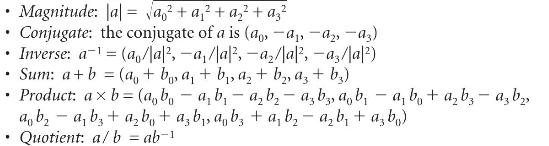
Create a data type Quaternion for quaternions and a test client that exercises all of your code. Quaternions extend the concept of rotation in three dimensions to four dimensions. They are used in computer graphics, control theory, signal processing, and orbital mechanics.
Magnitude: |a| = a + a + a + az . Conjugate: the conjugate of a is (ao, -a, -a, -az) Inverse: a = (a/la, -a/a, -a/a, -a3/a) Sum: a+b = (a + b, a + b, a + b, a3 + b) . Product: axb= (a, b, a, b-ab - a, b, a, b, a, b + ab3-a3b ab-ab+ ab + abab3 + ab-ab + ab) Quotient: a/b = ab-1 . . .
Step by Step Solution
3.41 Rating (151 Votes )
There are 3 Steps involved in it
The results from exercising the class methods q1 is Quaternion1 2 3 4 q2 is ... View full answer

Get step-by-step solutions from verified subject matter experts
 Study Help