



Question: Consider the free particle in one dimension: H = p 2 /2m. This Hamiltonian has both translational symmetry and inversion symmetry. (a) Show that translations
Consider the free particle in one dimension: Ĥ = p̂2/2m. This Hamiltonian has both translational symmetry and inversion symmetry.
(a) Show that translations and inversion don’t commute.
(b) Because of the translational symmetry we know that the eigenstates of Ĥ can be chosen to be simultaneous eigenstates of momentum, namely fp (x) (Equation 3.32). Show that the parity operator turns fp(x) into f-p (x); these two states must therefore have the same energy.
(c) Alternatively, because of the inversion symmetry we know that the eigenstates of Ĥ can be chosen to be simultaneous eigenstates of parity, namely
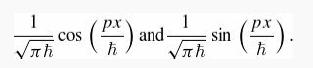
Show that the translation operator mixes these two states together; they therefore must be degenerate.

1 h COS px (P) a 1 dsin (P). and
Step by Step Solution
3.45 Rating (168 Votes )
There are 3 Steps involved in it
a Consider operating with the commutator on a test function fx ... View full answer

Get step-by-step solutions from verified subject matter experts