







Question: In this problem you will derive the expansion [x^{2}=frac{c^{2}}{2}+4 sum_{j=2}^{infty} frac{J_{0}left(alpha_{j} x ight)}{alpha_{j}^{2} J_{0}left(alpha_{j} c ight)}, quad 0 where the (alpha_{j}{ }^{prime} s) are the
In this problem you will derive the expansion
\[x^{2}=\frac{c^{2}}{2}+4 \sum_{j=2}^{\infty} \frac{J_{0}\left(\alpha_{j} x\right)}{\alpha_{j}^{2} J_{0}\left(\alpha_{j} c\right)}, \quad 0 where the \(\alpha_{j}{ }^{\prime} s\) are the positive roots of \(J_{1}(\alpha c)=0\), by following the below steps. a. List the first five values of \(\alpha\) for \(J_{1}(\alpha c)=0\) using Table 6. 3 and Figure 6. 8. [Be careful in determining \(\alpha_{1}\).] b. Show that \(\left\|J_{0}\left(\alpha_{1} x\right)\right\|^{2}=\frac{c^{2}}{2}\). Recall that \[\left\|J_{0}\left(\alpha_{j} x\right)\right\|^{2}=\int_{0}^{c} x J_{0}^{2}\left(\alpha_{j} x\right) d x\] c. Show that \(\left\|J_{0}\left(\alpha_{j} x\right)\right\|^{2}=\frac{c^{2}}{2}\left[J_{0}\left(\alpha_{j} c\right)\right]^{2}, j=2,3, \ldots\). (This is the most involved step.) First note from Problem 18 that \(y(x)=\) \(J_{0}\left(\alpha_{j} x\right)\) is a solution of \[x^{2} y^{\prime \prime}+x y^{\prime}+\alpha_{j}^{2} x^{2} y=0\] iv. Now you should have enough information to complete part d. d. Use the results from parts b, c, and problem 16 to derive the expansion coefficients for \[x^{2}=\sum_{j=1}^{\infty} c_{j} J_{0}\left(\alpha_{j} x\right)\] in order to obtain the desired expansion. Data from Table 6.3 Data from Figure 6.8 Data from Problem 18 Bessel functions \(J_{p}(\lambda x)\) are solutions of \(x^{2} y^{\prime \prime}+x y^{\prime}+\left(\lambda^{2} x^{2}-p^{2}\right) y=\) 0 . Assume that \(x \in(0,1)\) and that \(J_{p}(\lambda)=0\) and \(J_{p}(0)\) is finite. Data from 6.60 Data from 6.61 Data from 6.63
i. Verify the Sturm-Liouville form of this differential equation: \(\left(x y^{\prime}\right)^{\prime}=-\alpha_{j}^{2} x y\)
ii. Multiply the equation in part i. by \(y(x)\) and integrate from \(x=0\) to \(x=c\) to obtain \[\begin{align*} \int_{0}^{c}\left(x y^{\prime}\right)^{\prime} y d x & =-\alpha_{j}^{2} \int_{0}^{c} x y^{2} d x \\ & =-\alpha_{j}^{2} \int_{0}^{c} x J_{0}^{2}\left(\alpha_{j} x\right) d x \tag{6.172} \end{align*}\]
iii. Noting that \(y(x)=J_{0}\left(\alpha_{j} x\right)\), integrate the left-hand side by parts and use the following to simplify the resulting equation: 1. \(J_{0}^{\prime}(x)=-J_{1}(x)\) from Equation (6.6o). 2. Equation \((6.63)\) 3. \(J_{2}\left(\alpha_{j} c\right)+J_{0}\left(\alpha_{j} c\right)=0\) from Equation (6.61).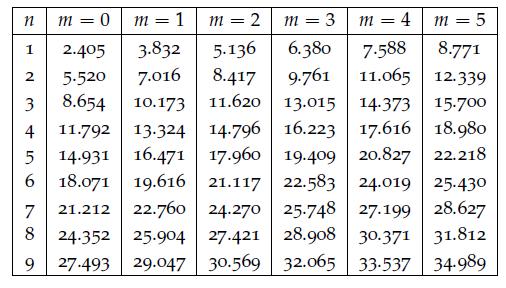
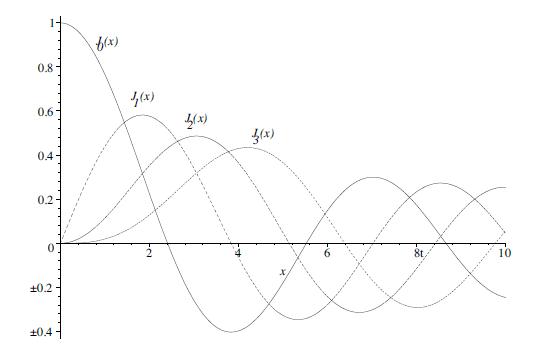



n m=0 m 1 = m 2m 3 = == m=4m=5 1 2.405 3.832 5.136 6.380 7.588 8.771 2 5.520 7.016 8.417 9.761 11.065 12.339 3 8.654 10.173 11.620 13.015 14.373 15.700 4 11.792 13.324 14.796 16.223 17.616 18.980 5 14.931 16.471 16.471 17.960 17.960 19.409 20.827 22.218 6 18.071 19.616 21.117 22.583 24.019 25.430 7 21.212 22.760 24.270 25.748 27.199 28.627 8 24.352 25.904 27.421 28.908 30.371 31.812 9 27.493 29.047 30.569 32.065 33-537 34.989
Step by Step Solution
3.39 Rating (152 Votes )
There are 3 Steps involved in it

Get step-by-step solutions from verified subject matter experts
 Study Help