







Question: DP10.3 NASA has identified the need for large deployable space structures, which will be constructed of lightweight materials and will contain large numbers of joints
DP10.3 NASA has identified the need for large deployable space structures, which will be constructed of lightweight materials and will contain large numbers of joints or structural connections. This need is evident for programs such as the space station. These deployable space structures may have precision shape requirements and a need for vibration suppression during in-orbit operations [16].
One such structure is the mast flight system, which is shown in Figure DP10.3(a). The intent of the system is to provide an experimental test bed for controls and dynamics. The basic element in the mast flight system is a 60.7-m-long truss beam structure, which is attached to the shuttle orbiter. Included at the tip of the truss structure are the primary actuators and collocated sensors. A deployment/retraction subsystem, which also secures the stowed beam package during launch and landing, is provided.
The system uses a large motor to move the structure and has the block diagram shown in Figure DP10.3(b).
The goal is a percent overshoot to a step response of P.O. … 20,; thus, we estimate the system z = 0.5 and the required phase margin as P.M. = 50°. Design for 0.75 6 K 6 2.0 and record the percent overshoot, rise time, and phase margin for selected gains.
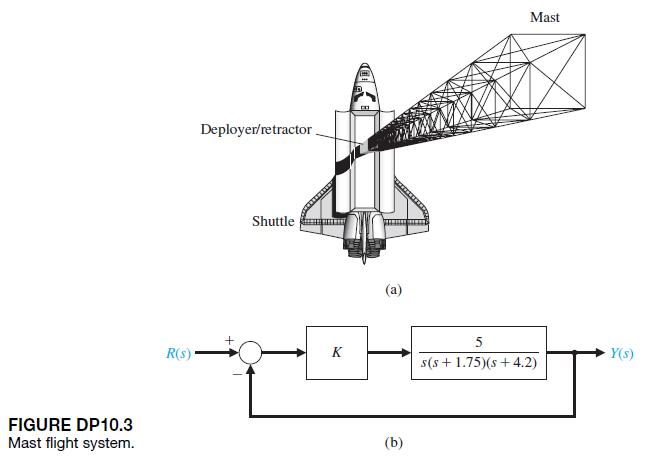
FIGURE DP10.3 Mast flight system. Deployer/retractor Shuttle Mast 5 R(s) K Y(s) s(s+1.75)(s+4.2) (b)
Step by Step Solution
There are 3 Steps involved in it

Get step-by-step solutions from verified subject matter experts
 Study Help