







Question: When a motor drives a flexible structure, the structures natural frequencies, as compared to the bandwidth of the servodrive, determine the contribution of the structural
When a motor drives a flexible structure, the structure’s natural frequencies, as compared to the bandwidth of the servodrive, determine the contribution of the structural flexibility to the errors of the resulting motion. In current industrial robots, the drives are often relatively slow, and the structures are relatively rigid, so that overshoots and other errors are caused mainly by the servodrive. However, depending on the accuracy required, the structural deflections of the driven members can become significant. Structural flexibility must be considered the major source of motion errors in space structures and manipulators.
Because of weight restrictions in space, large arm lengths result in flexible structures. Furthermore, future industrial robots should require lighter and more flexible manipulators.
To investigate the effects of structural flexibility and how different control schemes can reduce unwanted oscillations, an experimental apparatus was constructed consisting of a DC motor driving a slender aluminum beam. The purpose of the experiments was to identify simple and effective control strategies to deal with the motion errors that occur when a servomotor is driving a very flexible structure [13].
The experimental apparatus is shown in Figure P10.32(a), and the control system is shown in Figure P10.32(b). The goal is that the system will have a Kv of 100.
(a) When Gc1s2 = K, determine K and obtain the Bode plot. Find the phase margin and gain margin.
(b) Using the Nichols chart, find vr, Mpv, and vB.
(c) Select a compensator so that the phase margin is P.M. Ú 35° and find vr, Mpv, and vB for the compensated system.
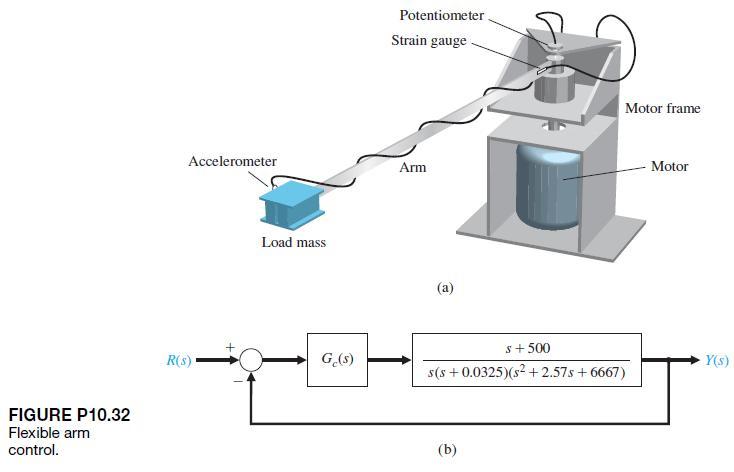
FIGURE P10.32 Flexible arm control. Accelerometer Load mass R(s) G(s) Potentiometer Strain gauge Arm s+500 s(s+0.0325)(s+2.57s+6667) (b) Motor frame Motor Y(s)
Step by Step Solution
There are 3 Steps involved in it

Get step-by-step solutions from verified subject matter experts
 Study Help