



Question: Although the customer loyalty project at Petrie Electronics had gone slowly at first, the past few weeks had been fast-paced and busy, Jim Watanabe, the
Although the customer loyalty project at Petrie Electronics had gone slowly at first, the past few weeks had been fast-paced and busy, Jim Watanabe, the project manager, thought to himself. He had spent much of his time planning and conducting interviews with key stakeholders inside the company. He had also worked with the marketing group to put together some focus groups made up of loyal customers, to get some ideas about what they would value in a customer loyalty program.
Jim had also spent some time studying customer loyalty programs at other big retail chains and those in other industries as well, such as the airlines, known for their extensive customer loyalty programs. As project manager, he had also supervised the efforts of his team members. Together, they had collected a great deal of data. Jim had just finished creating a high-level summary of the information into a table he could send to his team members (PE Table 6-1).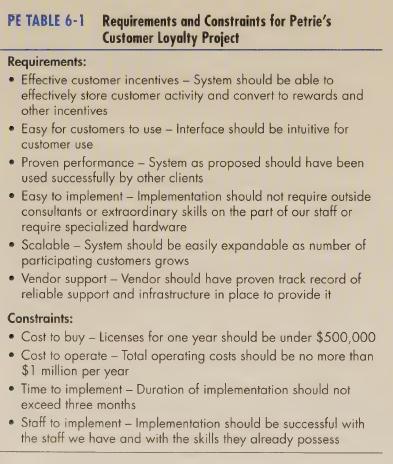
From the list of requirements, it was clear that he‘and his team did not favor building a system from scratch in-house. Jim was glad that the team felt that way. Not only was building a system like this in-house an antiquated practice, it was expensive and time consuming.
As nice as it might have been to develop a unique system just for Petrie, there was little point in reinventing the wheel. The IT staff would customize the system interface, and there would be lots of work for Sanjay’s staff in integrating the new system and its related components with Petrie’s existing systems, but the core of the system would have already been developed by someone else.
Just as he was finishing the e-mail he would send to his team about the new system’s requirements and constraints, he received a new message from Sanjay. He had asked Sanjay to take the lead in scouting out existing customer loyalty systems that Petrie could license. Sanjay had conducted a preliminary investigation that was now complete. His e-mail contained the descriptions of three of the systems he had found and studied (PE Table 6-2). Obviously, Jim and his team would need to have a lot more information about these alternatives, but Jim was intrigued by the possibilities. He sent a reply to Sanjay, asking him to pass the alternatives on to the team, and also asking him to prepare a briefing for the team that would include more detailed information about each alternative.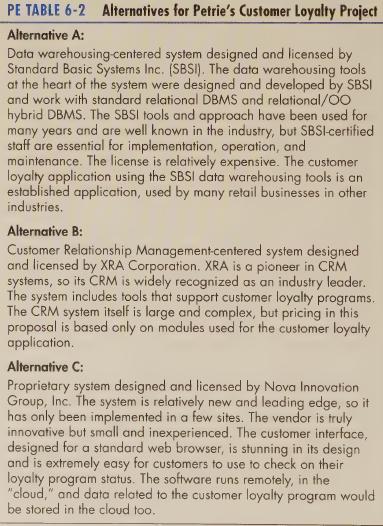
Questions
1. What do you think are the sources of the information Jim and his team collected? How do you think they collected all of that information?
2. Examine PE Table 6-1. Are there any requirements or constraints that you can think of that were overlooked? List them.
3. If you were looking for alternative approaches for Petrie's customer loyalty program, where would you look for information? Where would you start? How would you know when you were done?
4. Using the web, find three customizable customer loyalty program systems being sold by vendors. Create a table like PE Table 6-2 that compares them.
5. Why shouldn't Petrie's staff build their own unique system in-house?
PE TABLE 6-1 Requirements and Constraints for Petrie's Customer Loyalty Project Requirements: Effective customer incentives - System should be able to effectively store customer activity and convert to rewards and other incentives Easy for customers to use - Interface should be intuitive for customer use Proven performance - System as proposed should have been used successfully by other clients Easy to implement - Implementation should not require outside consultants or extraordinary skills on the part of our staff or require specialized hardware Scalable System should be easily expandable as number of participating customers grows Vendor support - Vendor should have proven track record of reliable support and infrastructure in place to provide it Constraints: Cost to buy - Licenses for one year should be under $500,000 Cost to operate - Total operating costs should be no more than $1 million per year Time to implement - Duration of implementation should not exceed three months Staff to implement - Implementation should be successful with the staff we have and with the skills they already possess
Step by Step Solution
3.52 Rating (149 Votes )
There are 3 Steps involved in it
Q1 What do you think are the sources of the information Jim and his team collected How do you think they collected all of that information Ans Jim and his team likely gathered their information from v... View full answer

Get step-by-step solutions from verified subject matter experts