







Question: Ming Chen began a professional practice on June 1 and plans to prepare financial statements at the end of each month. During June, Ming Chen
Ming Chen began a professional practice on June 1 and plans to prepare financial statements at the end of each month. During June, Ming Chen (the owner) completed these transactions.
a. Owner invested $60,000 cash in the company along with equipment that had a $15,000 market value.
b. The company paid $1,500 cash for rent of office space for the month.
c. The company purchased $10,000 of additional equipment on credit (payment due within 30 days).
d. The company completed work for a client and immediately collected the $2,500 cash earned.
e. The company completed work for a client and sent a bill for $8,000 to be received within 30 days.
f. The company purchased additional equipment for $6,000 cash.
g. The company paid an assistant $3,000 cash as wages for the month.
h. The company collected $5,000 cash as a partial payment for the amount owed by the client in transaction e.
i. The company paid $10,000 cash to settle the liability created in transaction c.
j. Owner withdrew $1,000 cash from the company for personal use.
Required
Create the following table similar to the one in Exhibit 1.9.

Then use additions and subtractions to show the dollar effects of the transactions on individual items of the accounting equation. Show new balances after each transaction.
EXHIBIT 1.9: Summary of Transactions Using the Accounting Equation
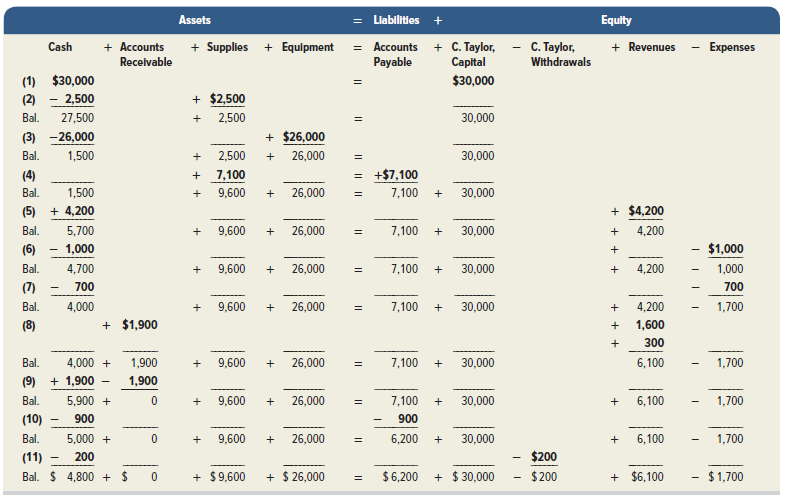
Equity Assets Liabilities + Expenses Cash + Receivable + Equipment = Payable + M. Chen, Capital M. Chen, + Revenues Accounts Accounts Withdrawals Assets Llabilitles Equity + Supplies + Equlpment + C. Taylor, Capital C. Taylor, + Revenues = Accounts Payable Cash + Accounts Expenses Recelvable Withdrawals (1) $30,000 (2) - 2,500 $30,000 + $2,500 Bal. 27,500 2,500 30,000 (3) -26,000 + $26,000 Bal. 1,500 2,500 26,000 30,000 (4) + 7,100 +$7,100 Bal. 1,500 9,600 26,000 7,100 30,000 (5) + 4,200 + $4,200 Bal. 5,700 9,600 26,000 7,100 30,000 4,200 (6) 1,000 $1,000 Bal. 4,700 9,600 26,000 7.100 30,000 4,200 1,000 (7) 700 700 Bal. 4,000 9,600 26,000 7,100 30,000 4,200 1,700 (8) + $1,900 1,600 300 Bal. 4,000 + 1,900 9,600 26,000 7,100 30,000 6,100 1,700 (9) + 1,900 - 1,900 Bal. 5,900 + 9,600 26,000 7,100 30,000 6,100 1,700 (10) 900 - 900 Bal. 5,000 + 9,600 26,000 6,200 30,000 6,100 1,700 (11) 200 $200 Bal. $ 4,800 + $ + $9,600 + $ 26,000 $6,200 + $ 30,000 $ 200 + $6,100 $ 1,700 I|||
Step by Step Solution
3.42 Rating (171 Votes )
There are 3 Steps involved in it
Assets Liabilities Equity Cash Accounts Receivable Equip ment Accounts Pa... View full answer

Get step-by-step solutions from verified subject matter experts
 Study Help