







Question: Using the results from Problem 10.10, derive the equations for both parts of the off-axis complex modulus, (E_{x}^{*}=E_{x}^{prime}left(1+i eta_{x} ight)), for an arbitrary angle (theta);
Using the results from Problem 10.10, derive the equations for both parts of the off-axis complex modulus, \(E_{x}^{*}=E_{x}^{\prime}\left(1+i \eta_{x}\right)\), for an arbitrary angle \(\theta\); then find numerical values of both parts for an angle of \(\theta=30^{\circ}\).
Problem 10.10
Extensional vibration experiments are conducted on longitudinal, transverse, and \(45^{\circ}\) off-axis unidirectional composite specimens, and the complex moduli results for a particular vibration frequency are, respectively:
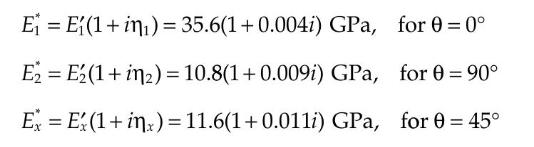
Using the above data derive the equations for both parts of the complex shear modulus, \(G_{12}^{*}=G_{12}^{\prime}\left(1+i \eta_{12}\right)\), then find numerical values for both parts. Assume that all loss factors are very small ( \(\ll 1)\), and that the major Poisson's ratio \(v_{12}=0.3\) is a real constant.
E=E(1+in)=35.6(1+0.0041) GPa, for 0=0 E2 E2(1+in2) = 10.8(1+0.009i) GPa, for 0 = 90 = Ex Ex(1+inx) = 11.6(1+0.011) GPa, for 0 = 45 =
Step by Step Solution
3.46 Rating (159 Votes )
There are 3 Steps involved in it

Get step-by-step solutions from verified subject matter experts
 Study Help