







Question: Literature problem. Over 2525 elements are essential to life. In J. Anal. Atom. Spec. 2018, 33, 1196, Open Access, Q. Zhang et al. developed a
Literature problem. Over 2525 elements are essential to life. In J. Anal. Atom. Spec. 2018, 33, 1196, Open Access, Q. Zhang et al. developed a method to simultaneously quantitate macro- and micronutrients in phytoplankton cultures.
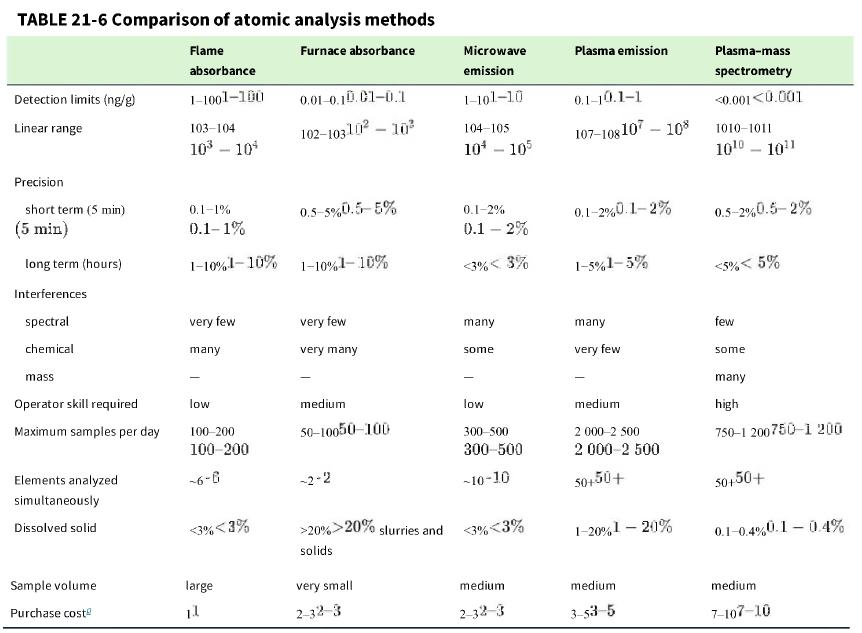
a. Thirty-two elements are analyzed down to parts-per-billion levels in samples with high (up to 30% 30%) dissolved solids. Use Figure 21-35 and Table 21-6 to predict the atomic spectrometric technique used.
b. Methods and Materials provides details of the instrumentation and procedures. In the Sample Preparation subsection, why was a laminar flow hood (clean air cabinet) used when handling reagents and samples?
c. Isobaric interferences may arise from the plasma or the sample matrix. Categorize the potential interferences for 56Fe+ 56Fe+ in Table 2 of the article as from the plasma or sample.
d. Results and Discussion details the results of studies and their significance. Why did the authors prefer to use kinetic energy discrimination rather than dynamic reaction?
e. Results are commonly summarized in figures and tables. Using an atomic spectrometric technique with a wide linear range allows analytes with widely different concentrations to be measured simultaneously. What is the concentration range of elements in BCR 414 certified reference material of plankton?
Figure 21-35

Table 21-6
Objective of analysis Quantitative Qualitative/ Semi-quantitative Number of elements to analyze Few Many Many Concentration expected As low as ppb As low as 100's ppt As low as ppt As low as ppb As low as 100's ppt As low as sub-ppt % to ppm Atomic spectrometry technique Flame atomic absorbance Graphite furnace atomic absorbance Atomic fluorescence Microwave plasma-optical emission Inductively coupled plasma- optical emission Inductively coupled plasma- mass spectrometry X-ray fluorescence Laser-induced breakdown spectroscopy Laser ablation-inductively coupled plasma As low as ppb Harris/Lucy, Quantitative Chemical Analysis, 10e, 2020 W. H. Freeman and Company FIGURE 21-35 Guide to atomic spectrometry technique selection. ppt = parts per trillion. [Information from S. Elliott, "Comparison of ICP-QQQ and MP-AES to Alternative Atomic Spectrometry Techniques," Am. Lab. March 2017, p. 20.]
Step by Step Solution
3.35 Rating (161 Votes )
There are 3 Steps involved in it
a Based on the information given it is likely that in the article by Q Zhang et al J Anal Atom Spec ... View full answer

Get step-by-step solutions from verified subject matter experts
 Study Help