







Question: Edwards has decided to use probability-proportional-to-size (PPS) sampling, sometimes called dollar-unit sampling, in the audit of a client's accounts receivable balance. Few, if any, misstatements
Edwards has decided to use probability-proportional-to-size (PPS) sampling, sometimes called dollar-unit sampling, in the audit of a client's accounts receivable balance. Few, if any, misstatements of the account balance are expected. Edwards plans to use the following PPS sampling table:

Required:
a. Identify the advantages of using PPS sampling over classical variables sampling.
b. Calculate the sampling interval and the sample size Edwards should use given the following information.
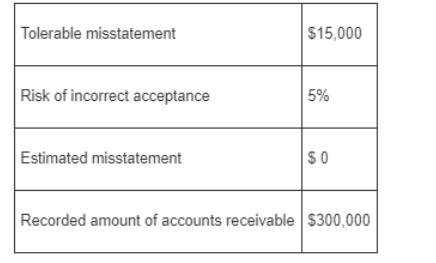
Requirements (c) through (f) are not related to (a) and (b).
c. Assuming a sampling interval of $5,000, calculate the total projected misstatement if the following three errors were discovered in a PPS sample:
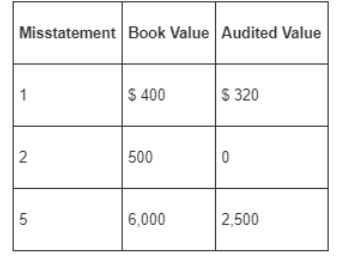
Number ofOverstatement Misstatements 0 2 3 4 Risk of Incorrect Acceptance 1% 5% 4.61 3.00 6.64 4.75 8.41 6.30 10.05 7.76 11.61 9.16 10% 2.31 3.89 5.33 6.69 8.00 15% 1.90 3.38 4.72 6.02 7.27 20% 1.61 3.00 4.28 5.52 6.73 Tolerable misstatement Risk of incorrect acceptance Estimated misstatement $15,000 5% $0 Recorded amount of accounts receivable $300,000 Misstatement Book Value Audited Value 1 2 5 $ 400 500 6,000 $ 320 0 2,500
Step by Step Solution
3.43 Rating (159 Votes )
There are 3 Steps involved in it
a Advantages of Using PPS Sampling Over Classical Variables Sampling 1 Simplicity PPS sampling is re... View full answer

Get step-by-step solutions from verified subject matter experts
Document Format (2 attachments)

6090944fdc192_21794.pdf
180 KBs PDF File

6090944fdc192_21794.docx
120 KBs Word File
 Study Help