







Question: 1. [-/1 Points] DETAILS OSCOLPHYS2016 25.1.P.001. MY NOTES ASK YOUR TEACHER PRACTICE ANOTHER Suppose a man stands in front of a mirror as shown in
![1. [-/1 Points] DETAILS OSCOLPHYS2016 25.1.P.001. MY NOTES ASK YOUR TEACHER](https://dsd5zvtm8ll6.cloudfront.net/si.experts.images/questions/2024/09/66f6fc03abb47_40366f6fc0358a4b.jpg)
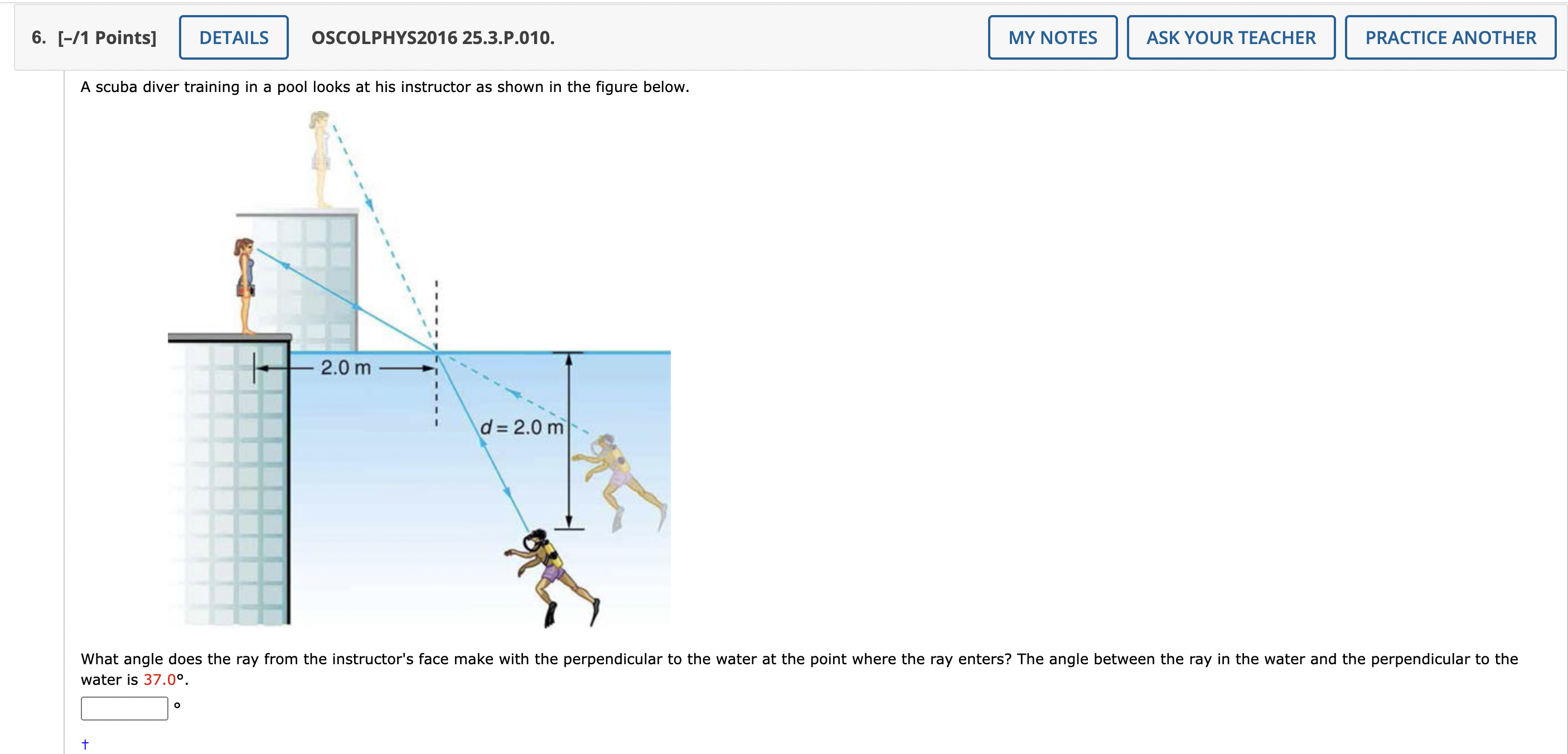
1. [-/1 Points] DETAILS OSCOLPHYS2016 25.1.P.001. MY NOTES ASK YOUR TEACHER PRACTICE ANOTHER Suppose a man stands in front of a mirror as shown in the figure below. His eyes are 1.61 m above the floor, and the top of his head is 0.12 m higher. Find the height (in m) above the floor of the top and bottom of the smallest mirror in which he can see both the top of his head and his feet. top m bottom m How is the distance d from the top to the bottom of the mirror related to the man's height h? (Use the symbol h.) d =6. [-/1 Points] DETAILS OSCOLPHYS2016 25.3.P.010. MY NOTES ASK YOUR TEACHER PRACTICE ANOTHER A scuba diver training in a pool looks at his instructor as shown in the figure below. 2.0 m d = 2.0 m What angle does the ray from the instructor's face make with the perpendicular to the water at the point where the ray enters? The angle between the ray in the water and the perpendicular to the water is 37.08. [-/1 Points] DETAILS OSCOLPHYSZO16 25.4.P.023. MY NOTES ASK YOUR TEACHER PRACTICE AN OTHER At what minimum angle will you get total internal reflection of light traveling in water and reected from ice? :1 1. Additional Materials ll'l Reading 9. [-/1 Points] DETAILS OSCOLPHY52016 25.4.WA.021.TUTORIAL. MY NOTES ASK YOUR TEACHER PRACTICE AN OTHER You have a beaker with a layer of olive oil oating on top of water. A ray of light travels through the oil and is incident on the water with an angle of 64.6. Using the index of refraction of the oil as 1.470 and the index of refraction of water as 1.333, determine the critical angle in oil for the oil-water interface. Determine if the ray of light retracts into the water or reflects off the oil-water interface back into the oil. 0 refracts into the water 0 reflects back into the oil 10. [I1 Points] DETAILS OSCOLPHYSZO16 25.5.P.028. MY NOTES ASK YOUR TEACHER PRACTICE ANOTHER (a) What is the percentage difference between the speeds of red light and violet light in polystyrene, based on the this table? /o (b) What is this percentage difference in diamond? u/o (c) which is more dispersive? ---Select--- v Additional Materials II] Reading 11. [-/1 Points] DETAILS OSCOLPHYSZO16 25.5.P.029. MY NOTES ASK YOUR TEACHER PRACTICE ANOTHER 'r A beam of white light goes from air into water at an incident angle of 76.0. At what angles are the green (550 nm) and violet (410 nm) parts of the light refracted? (Enter your answer to at least one decimal place.) green violet 12. [-/1 Points] DETAILS OSCOLPHYSZO16 25.6.P.036. MY NOTES ASK YOUR TEACHER PRACTICE AN OTHER What is the power in diopters of a camera lens that has a 56.5 mm focal length? :1 D .f Additional Material: III Reading 13. [-I1 Points] DETAILS OSCOLPHYSZO16 25.6.P.042. MY NOTES ASK YOUR TEACHER PRACTICE AN OTHER A doctor examines a mole with a 14.5 cm focal length magnifying glass held 14.0 cm from the mole. (a) Where is the image? (Enter the image distance in meters. Include the sign of the value in your answer.) m (b) What is its magnication? (c) How big in millimeters is the image of a 5.30 mm diameter mole? mm 14. [-/1 Points] DETAILS OSCOLPHYS2016 25.6.P.048. MY NOTES ASK YOUR TEACHER PRACTICE ANOTHER What magnification will be produced by a lens of power -4.10 D (such as might be used to correct myopia) if an object is held 22.5 cm away? X + Additional Materials Reading 15. [-/1 Points] DETAILS OSCOLPHYS2016 25.7.P.053. MY NOTES ASK YOUR TEACHER PRACTICE ANOTHER What is the focal length (in m) of a makeup mirror that has a power of 2.10 D? m16. [-/1 Points] DETAILS OSCOLPHYS2016 25.7.P.059. MY NOTES ASK YOUR TEACHER PRACTICE ANOTHER An object 1.50 cm high is held 3.15 cm from a person's cornea, and its reflected image is measured to be 0.165 cm high. (a) What is the magnification? (b) Where is the image (in cm)? cm (from the corneal "mirror") (c) Find the radius of curvature (in cm) of the convex mirror formed by the cornea. (Note that this technique is used by optometrists to measure the curvature of the cornea for contact lens fitting. The instrument used is called a keratometer, or curve measurer.) cm Additional Materials Reading 17. [-/1 Points] DETAILS OSCOLPHYS2016 25.7.P.063. MY NOTES ASK YOUR TEACHER PRACTICE ANOTHER Consider a room heater that uses a concave mirror to reflect infrared radiation from hot coils. The mirror has a radius of curvature of 47.0 cm and produces an image of the coils 2.60 m away from the mirror. Calculate the intensity of IR radiation in W/m projected by the concave mirror on a person 2.60 m away. Assume that the heating element radiates 1,250 W and has an area of 130 cm, and that half of the radiated power is reflected and focused by the mirror. w/m 2
Step by Step Solution
There are 3 Steps involved in it

Get step-by-step solutions from verified subject matter experts
 Study Help