Question: #1 (25 points) a) Give one prominent difference between DSSS and FHSS systems. (5 points) A communication system uses fast FHSS, transmitting at 50 kbps,
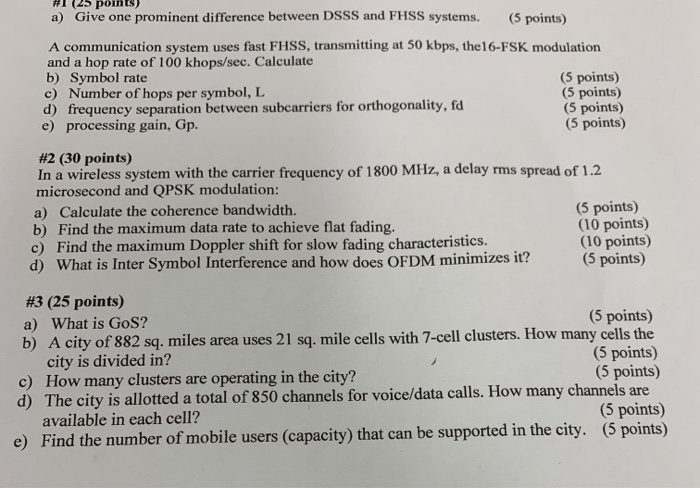
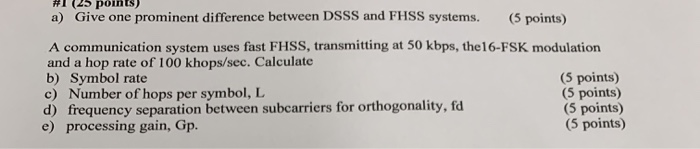
#1 (25 points) a) Give one prominent difference between DSSS and FHSS systems. (5 points) A communication system uses fast FHSS, transmitting at 50 kbps, the16-FSK modulation and a hop rate of 100 khops/sec. Calculate b) Symbol rate (5 points) c) Number of hops per symbol, L (5 points) d) frequency separation between subcarriers for orthogonality, fd (5 points) e) processing gain, Gp. (5 points) #2 (30 points) In a wireless system with the carrier frequency of 1800 MHz, a delay rms spread of 1.2 microsecond and QPSK modulation: a) Calculate the coherence bandwidth. (5 points) b) Find the maximum data rate to achieve flat fading. (10 points) c) Find the maximum Doppler shift for slow fading characteristics. (10 points) d) What is Inter Symbol Interference and how does OFDM minimizes it? (5 points) #3 (25 points) a) What is GoS? (5 points) b) A city of 882 sq. miles area uses 21 sq. mile cells with 7-cell clusters. How many cells the city is divided in? (5 points) c) How many clusters are operating in the city? (5 points) d) The city is allotted a total of 850 channels for voice/data calls. How many channels are available in each cell? (5 points) e) Find the number of mobile users (capacity) that can be supported in the city. (5 points) WI (25 points) a) Give one prominent difference between DSSS and FHSS systems. (5 points) A communication system uses fast FHSS, transmitting at 50 kbps, the 16-FSK modulation and a hop rate of 100 khops/sec. Calculate b) Symbol rate (5 points) c) Number of hops per symbol, L (5 points) d) frequency separation between subcarriers for orthogonality, fd (5 points) e) processing gain, Gp. (5 points) #1 (25 points) a) Give one prominent difference between DSSS and FHSS systems. (5 points) A communication system uses fast FHSS, transmitting at 50 kbps, the16-FSK modulation and a hop rate of 100 khops/sec. Calculate b) Symbol rate (5 points) c) Number of hops per symbol, L (5 points) d) frequency separation between subcarriers for orthogonality, fd (5 points) e) processing gain, Gp. (5 points) #2 (30 points) In a wireless system with the carrier frequency of 1800 MHz, a delay rms spread of 1.2 microsecond and QPSK modulation: a) Calculate the coherence bandwidth. (5 points) b) Find the maximum data rate to achieve flat fading. (10 points) c) Find the maximum Doppler shift for slow fading characteristics. (10 points) d) What is Inter Symbol Interference and how does OFDM minimizes it? (5 points) #3 (25 points) a) What is GoS? (5 points) b) A city of 882 sq. miles area uses 21 sq. mile cells with 7-cell clusters. How many cells the city is divided in? (5 points) c) How many clusters are operating in the city? (5 points) d) The city is allotted a total of 850 channels for voice/data calls. How many channels are available in each cell? (5 points) e) Find the number of mobile users (capacity) that can be supported in the city. (5 points) WI (25 points) a) Give one prominent difference between DSSS and FHSS systems. (5 points) A communication system uses fast FHSS, transmitting at 50 kbps, the 16-FSK modulation and a hop rate of 100 khops/sec. Calculate b) Symbol rate (5 points) c) Number of hops per symbol, L (5 points) d) frequency separation between subcarriers for orthogonality, fd (5 points) e) processing gain, Gp. (5 points)









 Study Help