







Question: 1. General Equilibrium: Consider the representative household, who chooses a path of consumption and leisure over an infinite horizon, {ct+s, lt+s}0, to maximize the
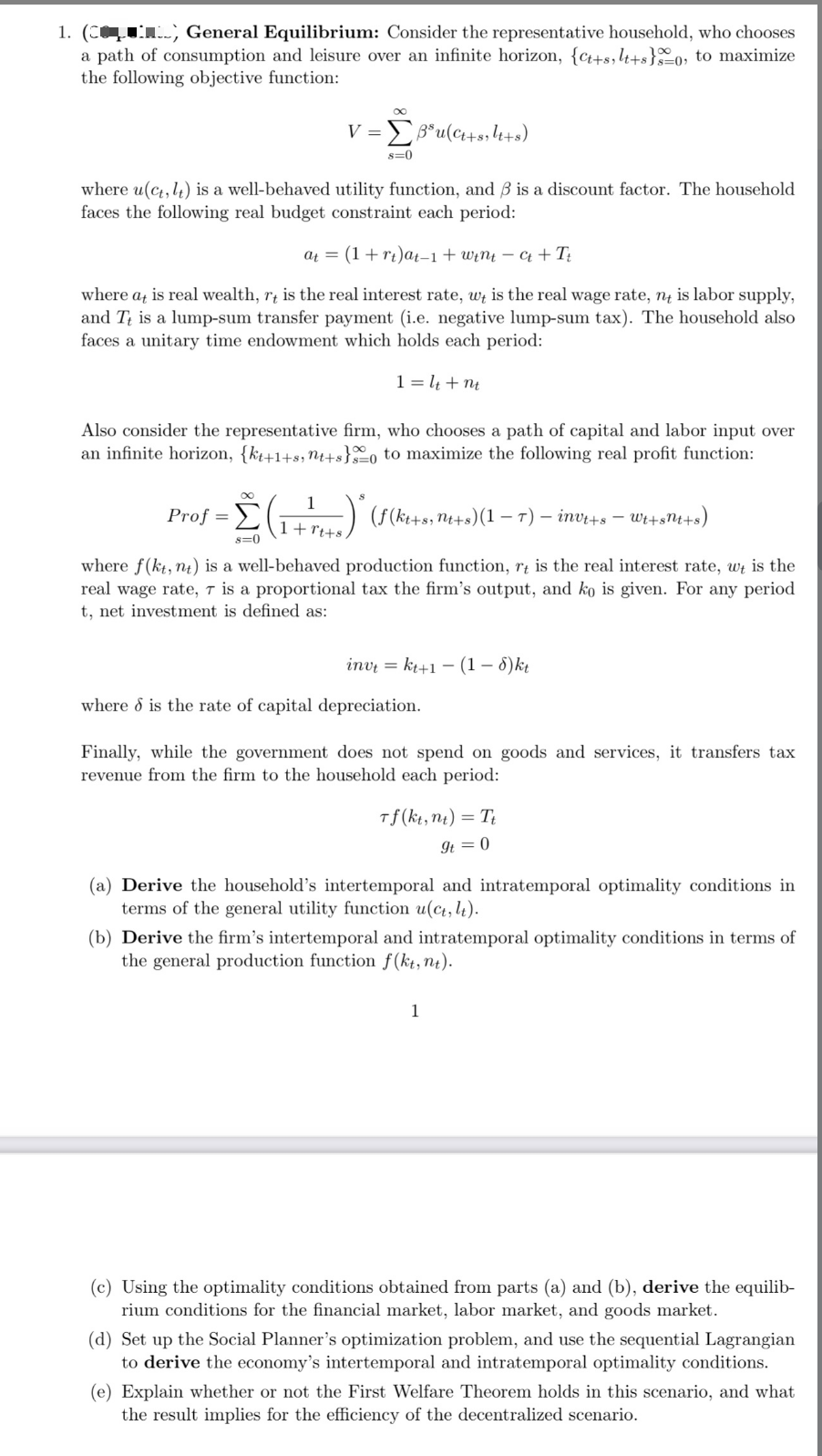
1. General Equilibrium: Consider the representative household, who chooses a path of consumption and leisure over an infinite horizon, {ct+s, lt+s}0, to maximize the following objective function: V = u(C++,4+8) 8=0 where u(c,t) is a well-behaved utility function, and is a discount factor. The household faces the following real budget constraint each period: at = (1+r)at-1+ Wnt - ct + T where at is real wealth, r+ is the real interest rate, w is the real wage rate, nt is labor supply, and T is a lump-sum transfer payment (i.e. negative lump-sum tax). The household also faces a unitary time endowment which holds each period: 1 = lt + nt Also consider the representative firm, who chooses a path of capital and labor input over an infinite horizon, {kt+1+s, nt+s}0 to maximize the following real profit function: Prof= 8=0 (1+1+)" (F (kits, m+s)(1 T) inv+s Wr+sM+s) where f(kt, nt) is a well-behaved production function, rt is the real interest rate, w is the real wage rate, 7 is a proportional tax the firm's output, and ko is given. For any period t, net investment is defined as: invt=kt+1 (1 6) kt where is the rate of capital depreciation. Finally, while the government does not spend on goods and services, it transfers tax revenue from the firm to the household each period: Tf (kt, nt) = Tt It = 0 (a) Derive the household's intertemporal and intratemporal optimality conditions in terms of the general utility function u(ct, lt). (b) Derive the firm's intertemporal and intratemporal optimality conditions in terms of the general production function f(kt, nt). 1 (c) Using the optimality conditions obtained from parts (a) and (b), derive the equilib- rium conditions for the financial market, labor market, and goods market. (d) Set up the Social Planner's optimization problem, and use the sequential Lagrangian to derive the economy's intertemporal and intratemporal optimality conditions. (e) Explain whether or not the First Welfare Theorem holds in this scenario, and what the result implies for the efficiency of the decentralized scenario.
Step by Step Solution
There are 3 Steps involved in it

Get step-by-step solutions from verified subject matter experts
 Study Help