



Question: 1. Name the two different types of procedures that are used to measure the amount of radioactivity internally deposited in a person. What are the

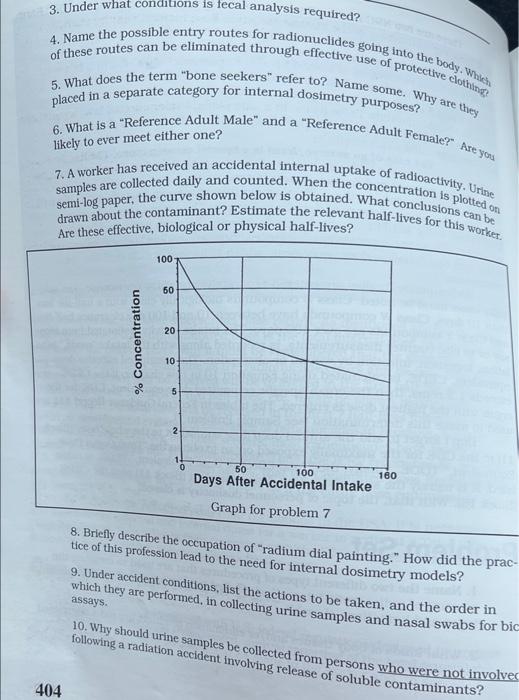
1. Name the two different types of procedures that are used to measure the amount of radioactivity internally deposited in a person. What are the advan- tages and limitations of each? 2. What kinds of body tissues and/or elimination products are most often used for analysis. 3. Under what conditions is fecal analysis required? 4. Name the possible entry routes for radionuclides going into the body. Which of these routes can be eliminated through effective use of protective clothing? 5. What does the term "bone seekers" refer to? Name some. Why are they placed in a separate category for internal dosimetry purposes? 6. What is a "Reference Adult Male" and a "Reference Adult Female?" Are you likely to ever meet either one? 7. A worker has received an accidental internal uptake of radioactivity. Urine samples are collected daily and counted. When the concentration is plotted on semi-log paper, the curve shown below is obtained. What conclusions can be drawn about the contaminant? Estimate the relevant half-lives for this worker. Are these effective, biological or physical half-lives? 100 50 0 50 100 160 Days After Accidental Intake Graph for problem 7 8. Briefly describe the occupation of "radium dial painting." How did the prac- tice of this profession lead to the need for internal dosimetry models? 9. Under accident conditions, list the actions to be taken, and the order in which they are performed, in collecting urine samples and nasal swabs for bic assays. 10. Why should urine samples be collected from persons who were not involver following a radiation accident involving release of soluble contaminants? 404 % Concentration 20 10 5 Internal Dose 11. Name some types of facilities where tritium might likely be handled. What special internal dosimetry problems would be involved in such facilities? What is the usual bioassay method for tritium? 12. Name the two types of whole body counters. List the advantages and disad- vantages of each type. 13. Why is pre-WW II steel preferred for shielded rooms that are used for whole body counting? 14. A worker submits a urine sample which shows a concentration of 57 micro- curies of H-3 per liter. He recalls an incident 4 days earlier in which he might have accidentally received the contamination. Calculate the initial body burden at the time of the accident. Calculate the activity in his body water at the time the sample was submitted. 15. Why do internally deposited radioisotopes follow the same routes as stable isotopes of the same elements? 16. How was the concept of critical organ used to establish radiation protection standards for internal dose situations? 17. Calculate the effective half-life for a nuclide with a physical half-life of 27 hours and a biological decay constant of 0.008 per minute. 18. A single 24 hour urine sample of 1.1 liters was collected from a worker who had inhaled P-32 10 days before the sample was obtained. The sample was sent to the counting lab via the U.S. Postal Service which misplaced it, and then finally delivered it 14.3 days after the sample was collected from the vic- tim. It was promptly counted to give 75 Bq/ml. If this worker had no other internal or external exposures for the year. has the annual 50 mSv dose limit been exceeded? 19. A worker at a nuclear power station is found to have a body burden of 83 microcuries of Cs-137 during a routine quarterly whole body count. His count in the preceding period was at background. Calculate the CEDE associated with this situation, assuming he inhaled the material. The 30, 60 and 90 day total body IRFs for inhalation (from NUREG/CR-4884) are 0.476, 0.394 and 0.325 respectively. 20. It has been determined that the likely isotope to be involved in a significant internal uptake accident at a radioactive source manufacturer is Am-241. This nuclide is used to make americium-beryllium neutron sources. Calculate the ratio of the dose equivalents to bone surfaces compared with the gonads for both inhalation and ingestion intake routes. Dose Factors from Federal Guid- ance Report 11 are tabulated as follows
Step by Step Solution
There are 3 Steps involved in it

Get step-by-step solutions from verified subject matter experts