





Question: (1) Prove or disprove : there exist a basis po, pi, p2, pa E PY(R) ( Py(R) is the set of all polynomial over real
(1) Prove or disprove : there exist a basis po,
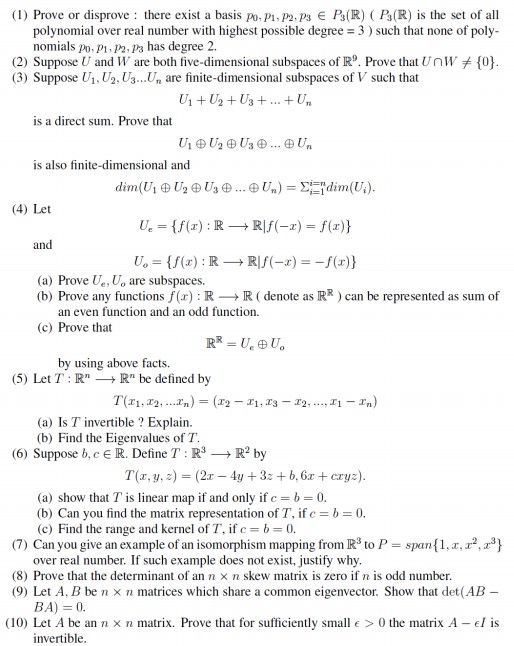
(1) Prove or disprove : there exist a basis po, pi, p2, pa E PY(R) ( Py(R) is the set of all polynomial over real number with highest possible degree = 3 ) such that none of poly- nomials po. P1, p2, pa has degree 2. (2) Suppose U and W are both five-dimensional subspaces of R". Prove that UnW / {0} (3) Suppose U1, U2, Us..U., are finite-dimensional subspaces of V such that U1 + U2 + Us + ... + Un is a direct sum. Prove that is also finite-dimensional and dim(Vi DU, OV, D ... OU.) = Effdim(U.). (4) Let Ue = {f(x) : R - R|f(-) = f(2) } and U. = {f(x) : R - R/(-x) = -f(x)} (a) Prove U., U. are subspaces. (b) Prove any functions f (x) : R -> IR ( denote as RR ) can be represented as sum of an even function and an odd function. (c) Prove that RR = U. OU. by using above facts. (5) Let T : R" - R" be defined by T(X1, 12. ...,) = (12 - 11, 13 - 12,..., 1] - In) (a) Is T invertible ? Explain. (b) Find the Eigenvalues of T. (6) Suppose b, c E R. Define T : R3 - R' by T(x, y, =) = (2x - 4y + 3: + b, 6x + cry:). (a) show that 7 is linear map if and only if c = b = 0. (b) Can you find the matrix representation of T, if c = b = 0. (c) Find the range and kernel of T, if c = b = 0. (7) Can you give an example of an isomorphism mapping from R* to P = span {1, x, x], x3 } over real number. If such example does not exist, justify why. (8) Prove that the determinant of an n x n skew matrix is zero if n is odd number. (9) Let A. B be n x n matrices which share a common eigenvector. Show that det(AB - BA) = 0. (10) Let A be an n x n matrix. Prove that for sufficiently small e > 0 the matrix A - c/ is invertible

Step by Step Solution

There are 3 Steps involved in it

1 Expert Approved Answer
Step: 1 Unlock blur-text-image

Question Has Been Solved by an Expert!

Get step-by-step solutions from verified subject matter experts

Step: 2 Unlock
Step: 3 Unlock

Students Have Also Explored These Related Mathematics Questions!