







Question: 1. Suppose end system A wants to send a large file to end system B. At a very high level: (4 marks) a. Describe by
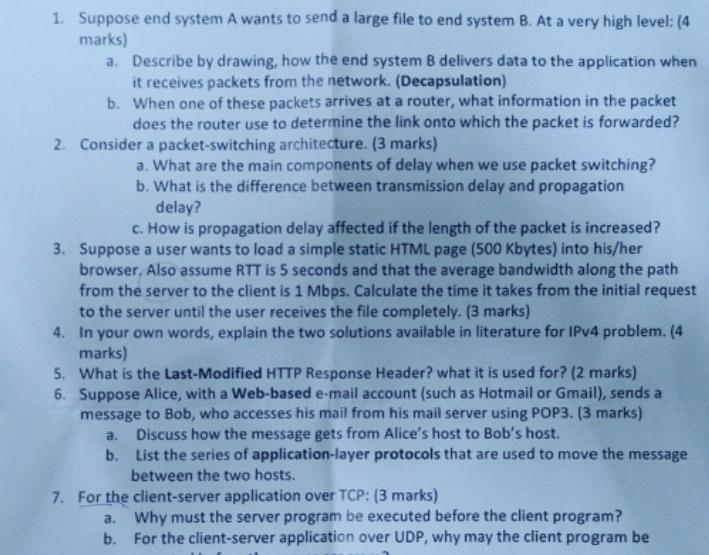
1. Suppose end system A wants to send a large file to end system B. At a very high level: (4 marks) a. Describe by drawing, how the end system B delivers data to the application when it receives packets from the network. (Decapsulation) b. When one of these packets arrives at a router, what information in the packet does the router use to determine the link onto which the packet is forwarded? 2. Consider a packet-switching architecture. ( 3 marks) a. What are the main components of delay when we use packet switching? b. What is the difference between transmission delay and propagation delay? c. How is propagation delay affected if the length of the packet is increased? 3. Suppose a user wants to load a simple static HTML page ( 500Kbytes ) into his/her browser. Also assume RT is 5 seconds and that the average bandwidth along the path from the server to the client is 1Mbps. Calculate the time it takes from the initial request to the server until the user receives the file completely. (3 marks) 4. In your own words, explain the two solutions available in literature for IPv4 problem. (4 marks) 5. What is the Last-Modified HTTP Response Header? what it is used for? (2 marks) 6. Suppose Alice, with a Web-based e-mail account (such as Hotmail or Gmail), sends a message to Bob, who accesses his mail from his mail server using POP3. (3 marks) a. Discuss how the message gets from Alice's host to Bob's host. b. List the series of application-layer protocols that are used to move the message between the two hosts. 7. For the client-server application over TCP: ( 3 marks) a. Why must the server program be executed before the client program? b. For the client-server application over UDP, why may the client program be
Step by Step Solution
There are 3 Steps involved in it

Get step-by-step solutions from verified subject matter experts
 Study Help