







Question: [16 marks) Here is a list of five propositional forms and three circuits. This list contains four pairs of logically equivalent entries (we will say
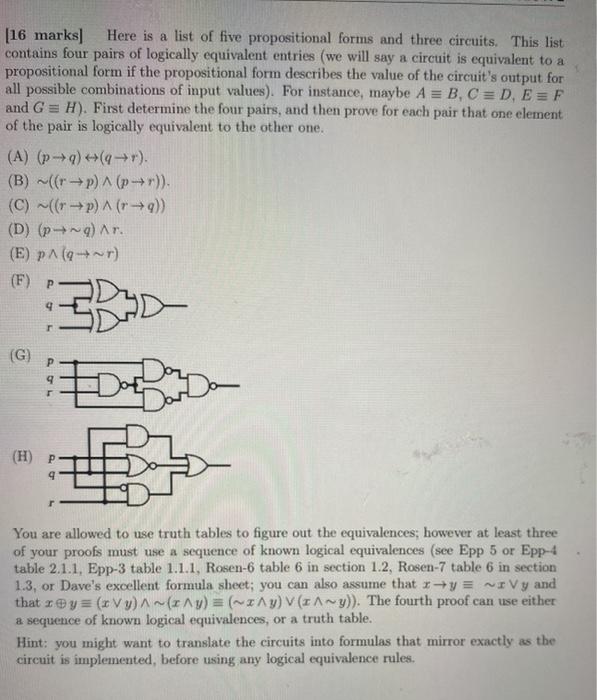



[16 marks) Here is a list of five propositional forms and three circuits. This list contains four pairs of logically equivalent entries (we will say a circuit is equivalent to a propositional form if the propositional form describes the value of the circuit's output for all possible combinations of input values). For instance, maybe A = B, C = D. E=F and G = H). First determine the four pairs, and then prove for each pair that one element of the pair is logically equivalent to the other one. (A) (-)-(q+r). (B) (( rp) +r)). (C) (( rp) ()) (D) (P+). (E) p^(9+) (F). P (G) (H) P 142 9 You are allowed to use truth tables to figure out the equivalences; however at least three of your proofs must use a sequence of known logical equivalences (sce Epp 5 or Epp-4 table 2.1.1. Epp-3 table 1.1.1, Rosen-6 table 6 in section 1.2, Rosen-7 table 6 in section 1.3, or Dave's excellent formula sheet; you can also assume that x+y= IV y and that xy = (y) (y) = (Ay) V(x^y)). The fourth proof can use either a sequence of known logical equivalences, or a truth table. Hint: you might want to translate the circuits into formulas that mirror exactly as the circuit is implemented, before using any logical equivalence rules, B expression 1 expression 2 reason ll! MINE . LIB expression 1 expression 2 reason = III III IND expression 1 expression 2 reason HEIM . d
Step by Step Solution
There are 3 Steps involved in it

Get step-by-step solutions from verified subject matter experts
 Study Help