







Question: 2. A storage medium is volatile; that is, items stored on it remain intact even when you turn off a computer or STUDENT ASSIGNMENTS Checkpoint
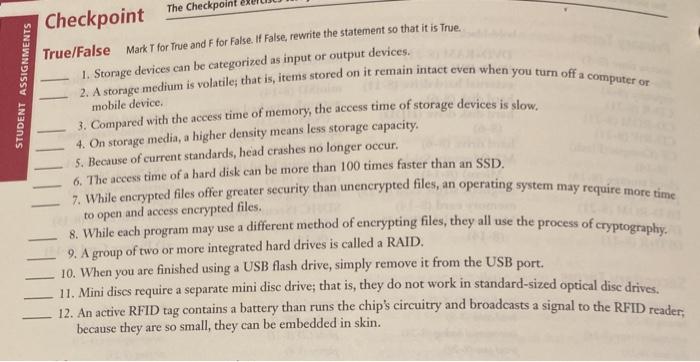
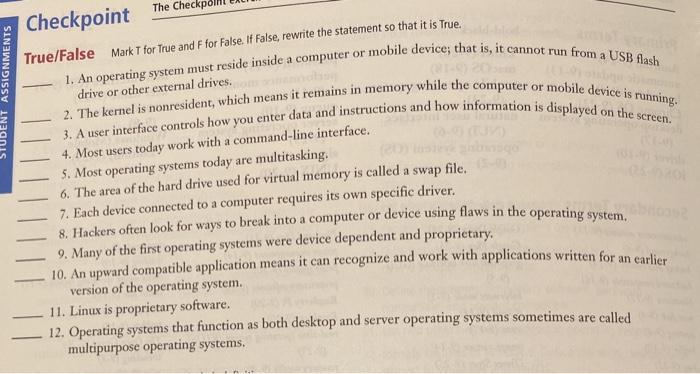
2. A storage medium is volatile; that is, items stored on it remain intact even when you turn off a computer or STUDENT ASSIGNMENTS Checkpoint The Checkpoint True/False Mark T for True and F for False. If False, rewrite the statement so that it is True 1. Storage devices can be categorized as input or output devices. mobile device. 3. Compared with the access time of memory, the access time of storage devices is slow. 4. On storage media, a higher density means less storage capacity. 5. Because of current standards, head crashes no longer occur. 6. The access time of a hard disk can be more than 100 times faster than an SSD. 2. While encrypted files offer greater security than unencrypted files, an operating system may require more time to open and access encrypted files. 8. While each program may use a different method of encrypting files, they all use the process of cryptography, 9. A group of two or more integrated hard drives is called a RAID. 10. When you are finished using a USB flash drive, simply remove it from the USB port. 11. Mini discs require a separate mini disc drive; that is, they do not work in standard-sized optical disc drives. 12. An active RFID tag contains a battery than runs the chip's circuitry and broadcasts a signal to the RFID reader, because they are so small, they can be embedded in skin. 1. An operating system must reside inside a computer or mobile device; that is, it cannot run from a USB flash 2. The kernel is nonresident, which means it remains in memory while the computer or mobile device is running. 3. A user interface controls how you enter data and instructions and how information is displayed on the screen. STUDENT ASSIGNMENTS Checkpoint The Checkpo True/False Mark T for True and F for False. If False, rewrite the statement so that it is True drive or other external drives. 4. Most users today work with a command-line interface. 5. Most operating systems today are multitasking. 6. The area of the hard drive used for virtual memory is called a swap file. 7. Each device connected to a computer requires its own specific driver. 8. Hackers often look for ways to break into a computer or device using flaws in the operating system. 9. Many of the first operating systems were device dependent and proprietary. 10. An upward compatible application means it can recognize and work with applications written for an earlier version of the operating system. 11. Linux is proprietary software. 12. Operating systems that function as both desktop and server operating systems sometimes are called multipurpose operating systems
Step by Step Solution
There are 3 Steps involved in it

Get step-by-step solutions from verified subject matter experts
 Study Help