







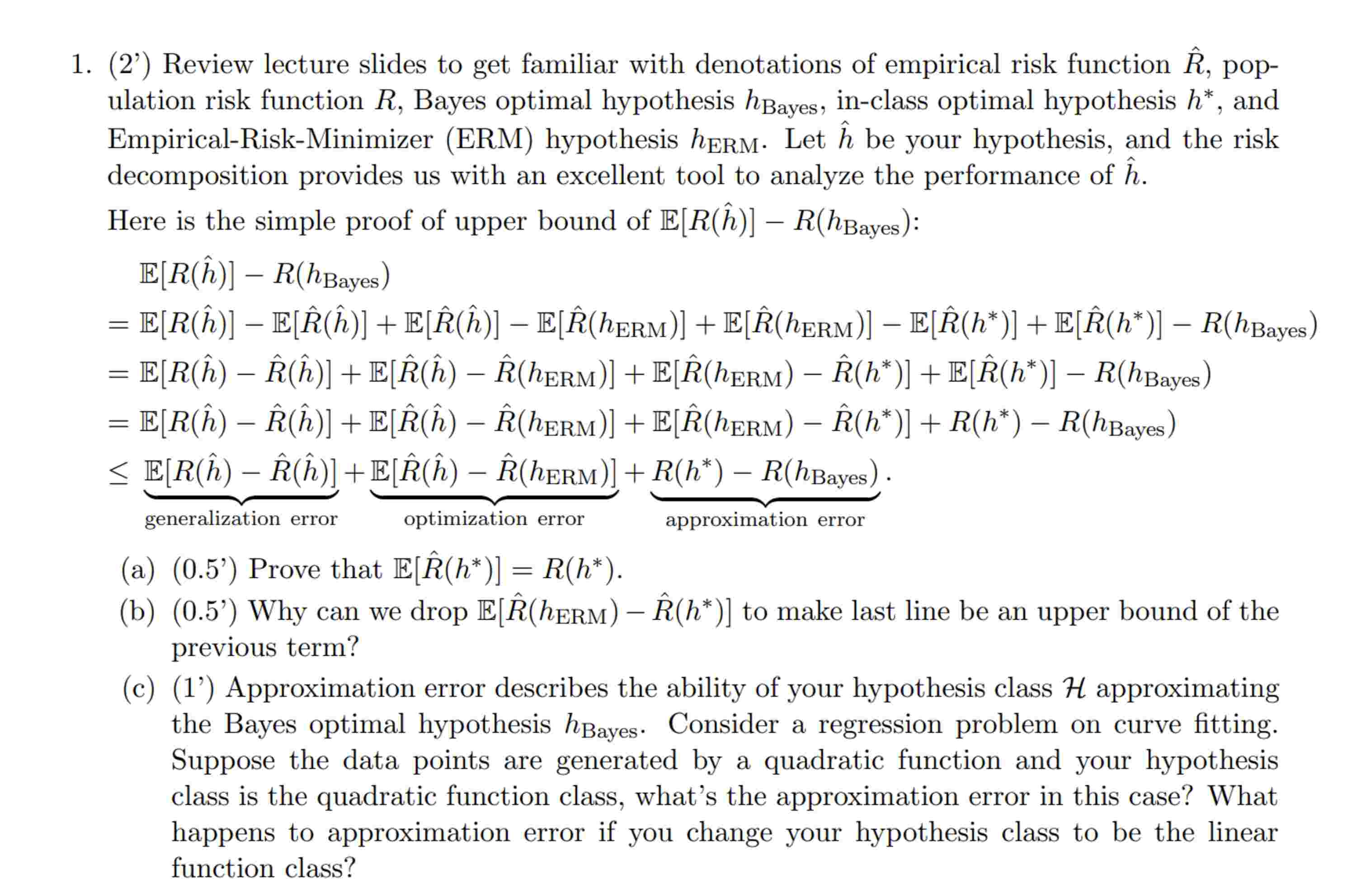
Question: ( 2 ' ) Review lecture slides to get familiar with denotations of empirical risk function hat ( R ) , pop - ulation risk
Review lecture slides to get familiar with denotations of empirical risk function hatR pop
ulation risk function R Bayes optimal hypothesis hBayes inclass optimal hypothesis h and
EmpiricalRiskMinimizer ERM hypothesis hERM Let hath be your hypothesis, and the risk
decomposition provides us with an excellent tool to analyze the performance of hath
Here is the simple proof of upper bound of ERhathRhBayes :
ERhathRhBayes
ERhathEhatRhathEhatRhathEhatRhERMEhatRhERMEhatRhEhatRhRhBayes
ERhathhatRhathEhatRhathhatRhERMEhatRhERMhatRhEhatRhRhBayes
ERhathhatRhathEhatRhathhatRhERMEhatRhERMhatRhRhRhBayes
ubraceERhathhatRhathubracegeneralization error ubraceEhatRhathhatRhERMubraceoptimization error ubraceRhRhBayes ubraceapproximation error
a Prove that EhatRhRh
b Why can we drop EhatRhERMhatRh to make last line be an upper bound of the
previous term?
c Approximation error describes the ability of your hypothesis class H approximating
the Bayes optimal hypothesis hBayes Consider a regression problem on curve fitting.
Suppose the data points are generated by a quadratic function and your hypothesis
class is the quadratic function class, what's the approximation error in this case? What
happens to approximation error if you change your hypothesis class to be the linear
function class?
Step by Step Solution
There are 3 Steps involved in it
1 Expert Approved Answer
Step: 1 Unlock

Question Has Been Solved by an Expert!
Get step-by-step solutions from verified subject matter experts
Step: 2 Unlock
Step: 3 Unlock
 Study Help