







Question: 2.1. Consider three strings A-11101111, A2 - 00010100, and A, - 01000011 and six schemata H1**, H2 0, H, *11 H, 0.00, Hs - i
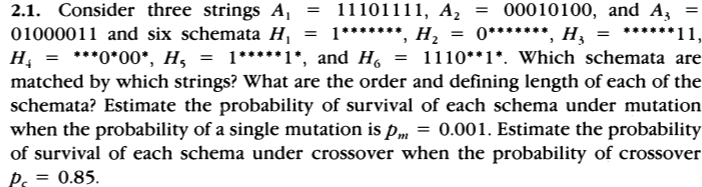
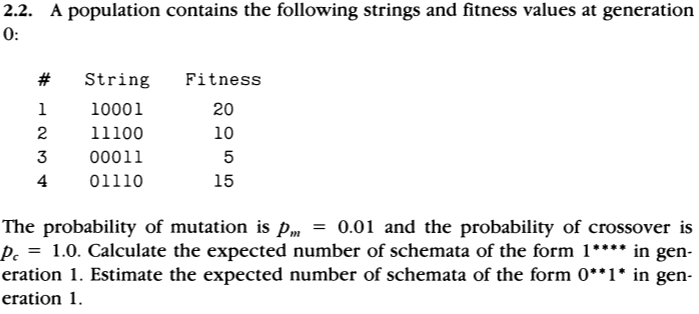

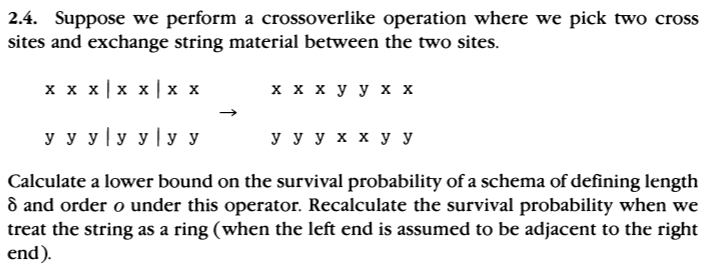
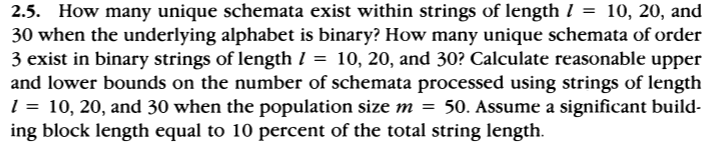
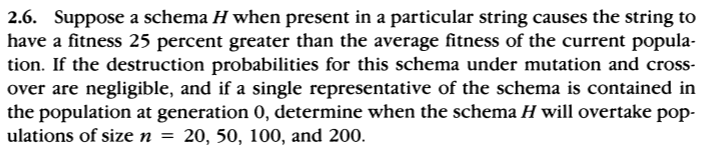
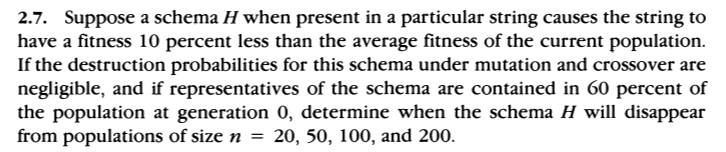



2.1. Consider three strings A-11101111, A2 - 00010100, and A, - 01000011 and six schemata H1**, H2 0, H, *11 H, 0.00", Hs - i i. and H6-1110.. 1.. Which schemata are matched by which strings? What are the order and defining length of each of the schemata? Estimate the probability of survival of each schema under mutation when the probability of a single mutation is p-0.001. Estimate the probability of survival of each schema under crossover when the probability of crossover p - 0.85. A population contains the following strings and fitness values at generation 2.2. 0: # String Fitness 10001 11100 3 00011 4 01110 20 10 2 15 The probability of mutation is p," 0.01 and the probability of crossover is p.0. Calculate the expected number of schemata of the form 1*" in gen- eration 1. Estimate the expected number of schemata of the form 0*1* in gen- eration 1 2.3. Devise three methods of performing reproduction and calculate an estimate of the expected number of schemata in the next generation under each method. 2.4. Suppose we perform a crossoverlike operation where we pick two cross sites and exchange string material between the two sites. x x x x Xx x yy y x x y y Calculate a lower bound on the survival probability of a schema of defining length 8 and order o under this operator. Recalculate the survival probability when we treat the string as a ring (when the left end is assumed to be adjacent to the right end). 2.6. Suppose a schema H when present in a particular string causes the string to have a fitness 25 percent greater than the average fitness of the current popula- tion. If the destruction probabilities for this schema under mutation and cross- over are negligible, and if a single representative of the schema is contained in the population at generation 0, determine when the schema H will overtake pop- ulations of size n - 20, 50, 100, and 200. tna for this schema under 2.7. Suppose a schema H when present in a particular string causes the string to have a fitness 10 percent less than the average fitness of the current population. If the destruction probabilities for this schema under mutation and crossover are negligible, and if representatives of the schema are contained in 60 percent of the population at generation 0, determine when the schema H will disappear from populations of size n - 20, 50, 100, and 200. 2.8. A two-armed bandit pays equal awards with probabilities p0.7 and Pa = 0.3. Estimate the number of trials that should be given to the observed best arm after a total of 50 trials. 2.9. Derive a more accurate formula for calculating the number of unique sche- mata contained in a randomly generated initial population of size m when the string length is L (Hint Consider the probability of having no schemata of a particular order and use the complementary probability to count the number of schemata represented by one or more.) 2.10. Suppose a problem is coded as a single unsigned binary integer between 0 and 127 (base 10), where 00000002 010, 10000002 - 6410, and 111 1 111 - 127. Sketch the portion of the space covered by the following schemata: 1" 2.1. Consider three strings A-11101111, A2 - 00010100, and A, - 01000011 and six schemata H1**, H2 0, H, *11 H, 0.00", Hs - i i. and H6-1110.. 1.. Which schemata are matched by which strings? What are the order and defining length of each of the schemata? Estimate the probability of survival of each schema under mutation when the probability of a single mutation is p-0.001. Estimate the probability of survival of each schema under crossover when the probability of crossover p - 0.85. A population contains the following strings and fitness values at generation 2.2. 0: # String Fitness 10001 11100 3 00011 4 01110 20 10 2 15 The probability of mutation is p," 0.01 and the probability of crossover is p.0. Calculate the expected number of schemata of the form 1*" in gen- eration 1. Estimate the expected number of schemata of the form 0*1* in gen- eration 1 2.3. Devise three methods of performing reproduction and calculate an estimate of the expected number of schemata in the next generation under each method. 2.4. Suppose we perform a crossoverlike operation where we pick two cross sites and exchange string material between the two sites. x x x x Xx x yy y x x y y Calculate a lower bound on the survival probability of a schema of defining length 8 and order o under this operator. Recalculate the survival probability when we treat the string as a ring (when the left end is assumed to be adjacent to the right end). 2.6. Suppose a schema H when present in a particular string causes the string to have a fitness 25 percent greater than the average fitness of the current popula- tion. If the destruction probabilities for this schema under mutation and cross- over are negligible, and if a single representative of the schema is contained in the population at generation 0, determine when the schema H will overtake pop- ulations of size n - 20, 50, 100, and 200. tna for this schema under 2.7. Suppose a schema H when present in a particular string causes the string to have a fitness 10 percent less than the average fitness of the current population. If the destruction probabilities for this schema under mutation and crossover are negligible, and if representatives of the schema are contained in 60 percent of the population at generation 0, determine when the schema H will disappear from populations of size n - 20, 50, 100, and 200. 2.8. A two-armed bandit pays equal awards with probabilities p0.7 and Pa = 0.3. Estimate the number of trials that should be given to the observed best arm after a total of 50 trials. 2.9. Derive a more accurate formula for calculating the number of unique sche- mata contained in a randomly generated initial population of size m when the string length is L (Hint Consider the probability of having no schemata of a particular order and use the complementary probability to count the number of schemata represented by one or more.) 2.10. Suppose a problem is coded as a single unsigned binary integer between 0 and 127 (base 10), where 00000002 010, 10000002 - 6410, and 111 1 111 - 127. Sketch the portion of the space covered by the following schemata: 1
Step by Step Solution
There are 3 Steps involved in it

Get step-by-step solutions from verified subject matter experts
 Study Help