







Question: 3 . Cook - Levin windows. Recall from lecture that one critical ingredient in the proof of the Cook - Levin theorem is to specify
CookLevin windows.
Recall from lecture that one critical ingredient in the proof of the CookLevin theorem is to
specify which contents of the xx "windows" of the verifier's computation tableau are valid.
Specify all the valid xx window contents that could appear in two adjacent rows of the
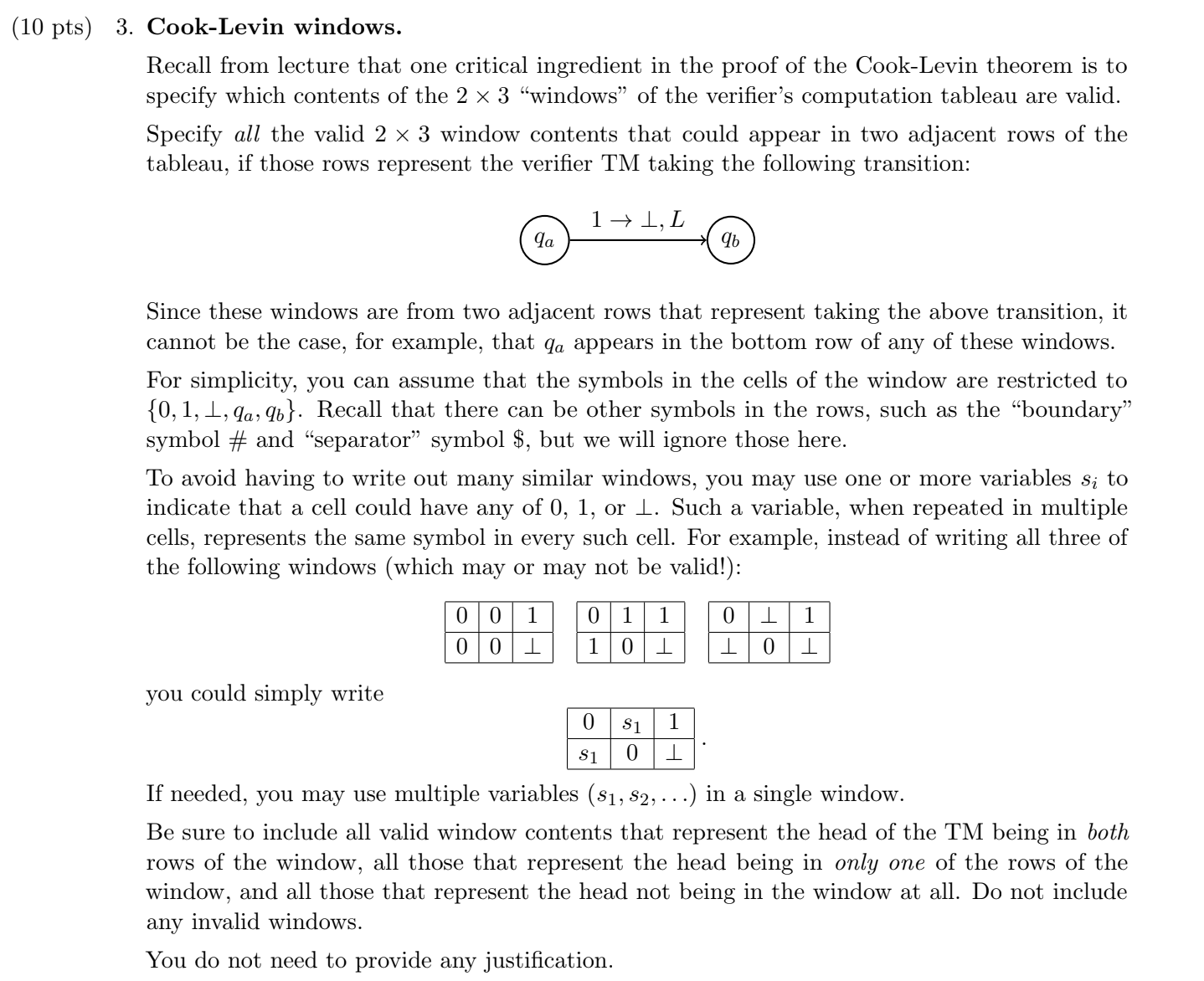
tableau, if those rows represent the verifier TM taking the following transition:
Since these windows are from two adjacent rows that represent taking the above transition, it
cannot be the case, for example, that qa appears in the bottom row of any of these windows.
For simplicity, you can assume that the symbols in the cells of the window are restricted to
qaqb Recall that there can be other symbols in the rows, such as the "boundary"
symbol # and "separator" symbol $ but we will ignore those here.
To avoid having to write out many similar windows, you may use one or more variables si to
indicate that a cell could have any of or Such a variable, when repeated in multiple
cells, represents the same symbol in every such cell. For example, instead of writing all three of
the following windows which may or may not be valid!:
you could simply write
If needed, you may use multiple variables ssdots in a single window.
Be sure to include all valid window contents that represent the head of the TM being in both
rows of the window, all those that represent the head being in only one of the rows of the
window, and all those that represent the head not being in the window at all. Do not include
any invalid windows.
You do not need to provide any justification.
Step by Step Solution
There are 3 Steps involved in it
1 Expert Approved Answer
Step: 1 Unlock

Question Has Been Solved by an Expert!
Get step-by-step solutions from verified subject matter experts
Step: 2 Unlock
Step: 3 Unlock
 Study Help