







Question: 3.1-1 Let f(n) and g(n) be asymptotically nonnegative functions. Using the basic definition of O-notation, prove that max{f(n), g(n)}=O(f(n)+g(n)). 3.1-2 Show that for any real

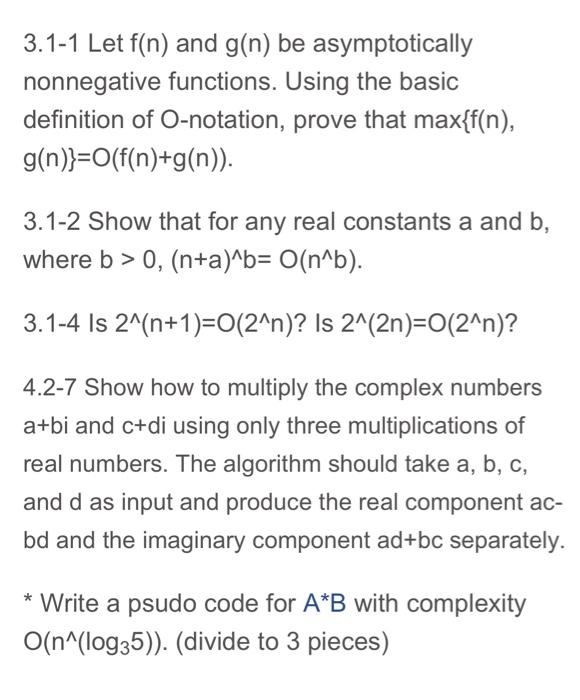
3.1-1. Lotta) and gin) be asymptotically nonnegative functions. Using the best definition of Ornotation, prove that mattinon=0X1+91), 3.1.2 Show that for any real constants and b. where b>0. inayte Onb) 3.1.4 is 2n-1)=022 is 242)=0/2? 42-7 Show to multiply the complex number stand ting only there mutilations of relates the shot. Cand out and produceret component ac-bd and the imaginary component separately Wito a pudo code for AB with complexity On"09:51) (divide to 3 places) 3.1-1 Let f(n) and g(n) be asymptotically nonnegative functions. Using the basic definition of O-notation, prove that max{f(n), g(n)}=O(f(n)+g(n)). 3.1-2 Show that for any real constants a and b, where b > 0, (n+a)^b= O(n^b). 3.1-4 Is 2^(n+1)=0(2^n)? Is 2^(2n)=0(2^n)? 4.2-7 Show how to multiply the complex numbers a+bi and c+di using only three multiplications of real numbers. The algorithm should take a, b, c, and d as input and produce the real component ac- bd and the imaginary component ad+bc separately. * Write a psudo code for A*B with complexity O(n^(log35)). (divide to 3 pieces)
Step by Step Solution
There are 3 Steps involved in it

Get step-by-step solutions from verified subject matter experts
 Study Help