







Question: 4. The Hydrogenic Atom The Bohr radius is defined by coevention not as the mean radias of the electron, bet as the 'most likely radins'
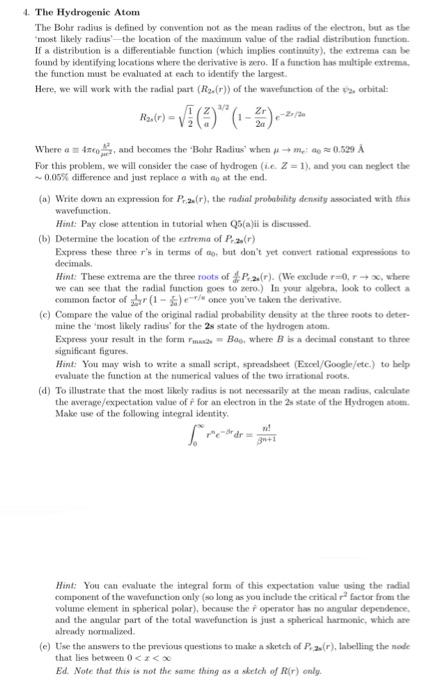
4. The Hydrogenic Atom The Bohr radius is defined by coevention not as the mean radias of the electron, bet as the 'most likely radins' - the location of the maximum value of the radial distribution function. If a distribution is a differentiable function (which implies continuity), the extrema can be found by identifying locstions where the derivative is zero. If a fusction has multiple extrema. the function must be evalnated at each to identify the largest. Here, we will work with the radial part (R2(r)) of the wavefunction of the w2, erbital- R2s(r)=21(aZ)3/2(12aZr)e2r/2a Where a 4x02s2, and becomes the 'Bohr Radius' whed me:ae0.529A For this problem, we will consider the case of hydrogen (i.e. Z=1 ), and you can neglect the 0,05% difference and just replace a with a0 at the end. (a) Write down an expression for Pr,2(r), the rudad probabily density asociated with shas Wavefunction. Hint: Pay close attention in tutorial when Q5(a) ii is discuseed (b) Determine the location of the extrma of Pr.20(r) Express these three r2 in in terms of a , but don't yet coevert rational expressions to decinals. Hint: These extrema are the three roots of 41Pr,20(r). (We exelude r=0,r, where we caa see that the radial function goes to pero.) In your algebra, look to collect a comason factor of 2g1r(125)er// obee you've taken the detivative. (c) Compare the value of the original radial probability density at the three roots to determine the 'most likely radias' for the 2s state of the Lydrogen aton. Express your result in the form rmasos=Ba0, where B is a decimal constant to three significant figures. Hint: You may wish to write a sumall script, spreadsbeet (Excel/Google/ete) to belp evaluate the function at the numerical values of the twe irrational roots. (d) To illustrate that the most lakely radines is not necesarily at the meas radias, calculate the average/expectation value of r^ for an electroa in the 2 s state of the Hydrogen atotn. Make ase of the following integral identity. 0rne3rdr=n+1n! Hint: You can evaluate the integral form of this expectation value using the radial component of the wavefunction only (so long as you inchade the eritical r2 factor from the volume element in spherical polar), because the r operater has no angular dependence. and the angular part of the total wavefunction is just a spherical harmonic, which are already nornuliand. (c) Use the answers to the previous questions to make a sketd of P,z.(r), latielling the nede that lies between 0
Step by Step Solution
There are 3 Steps involved in it

Get step-by-step solutions from verified subject matter experts
 Study Help