Question: 4.2 Probing Acid-Base Properties of pH-Sensitive Dyes with Liquid-Liquid Extraction Scen ario: You may have used pH indicators in previous chemistry experiments, but have you
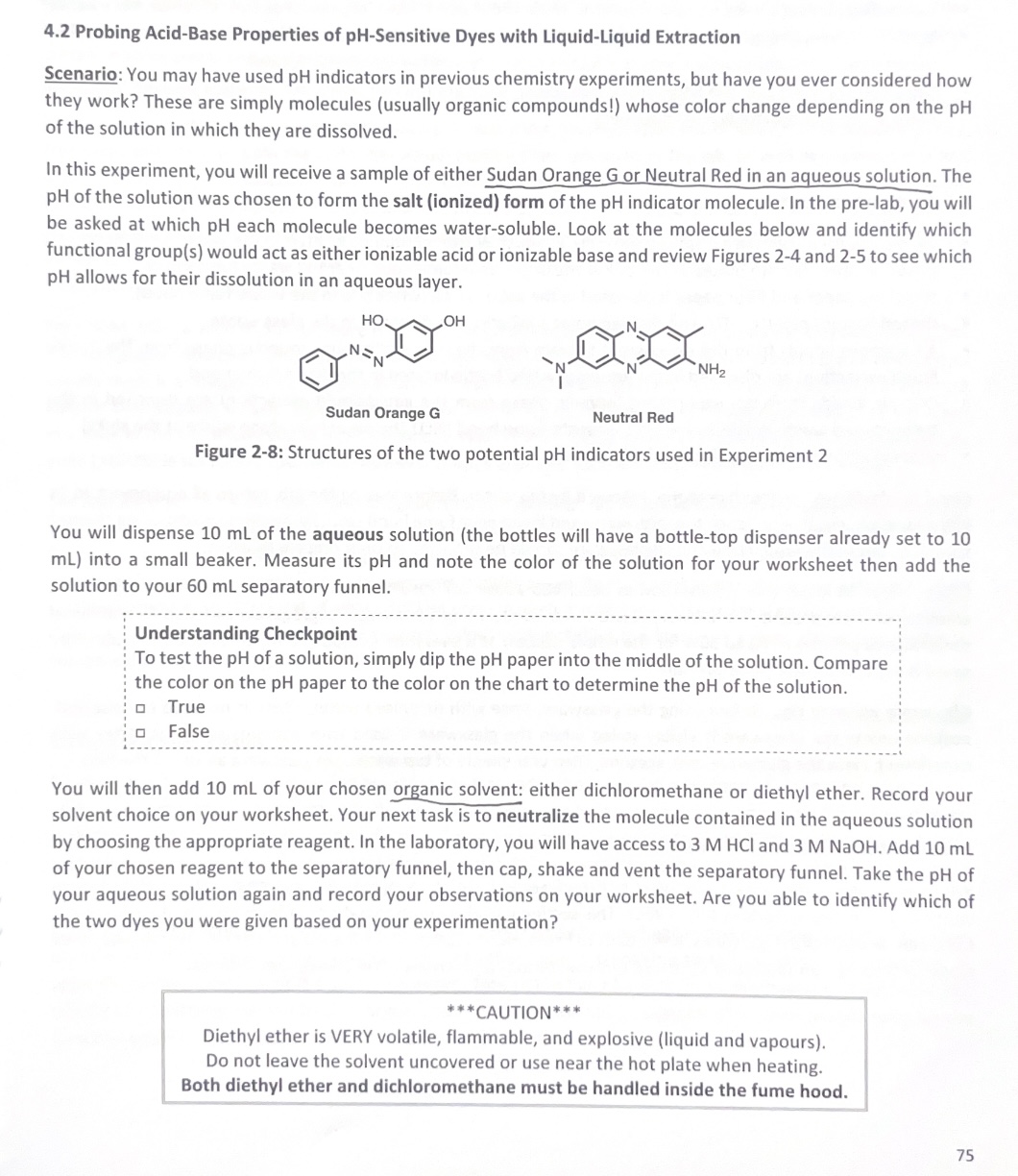
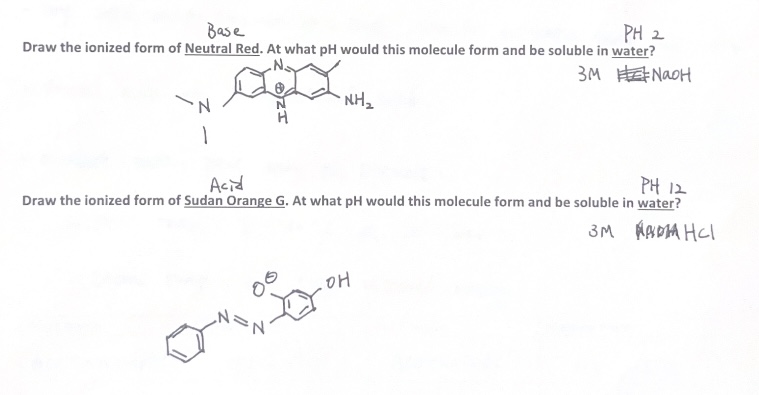
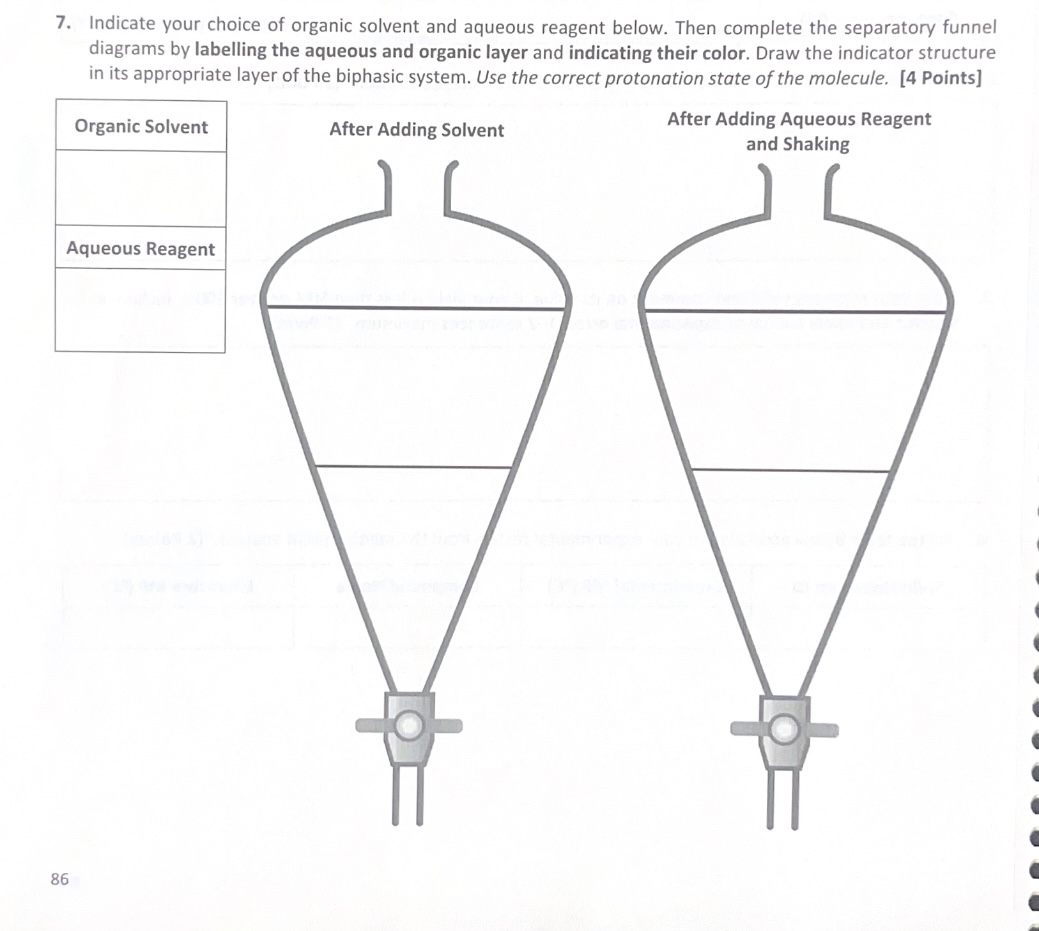
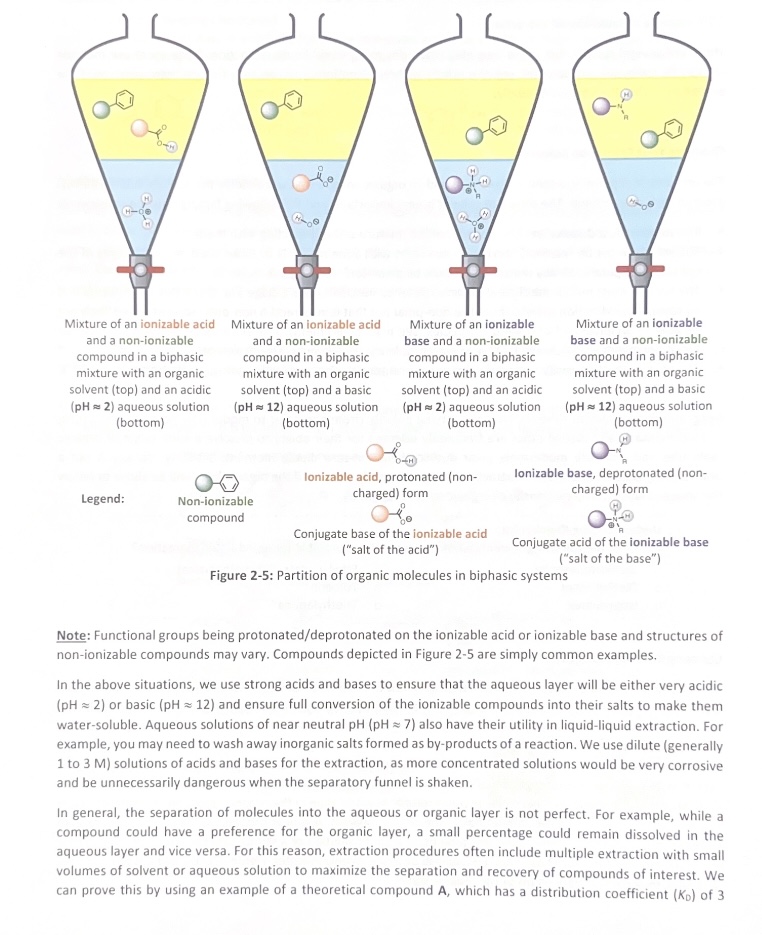
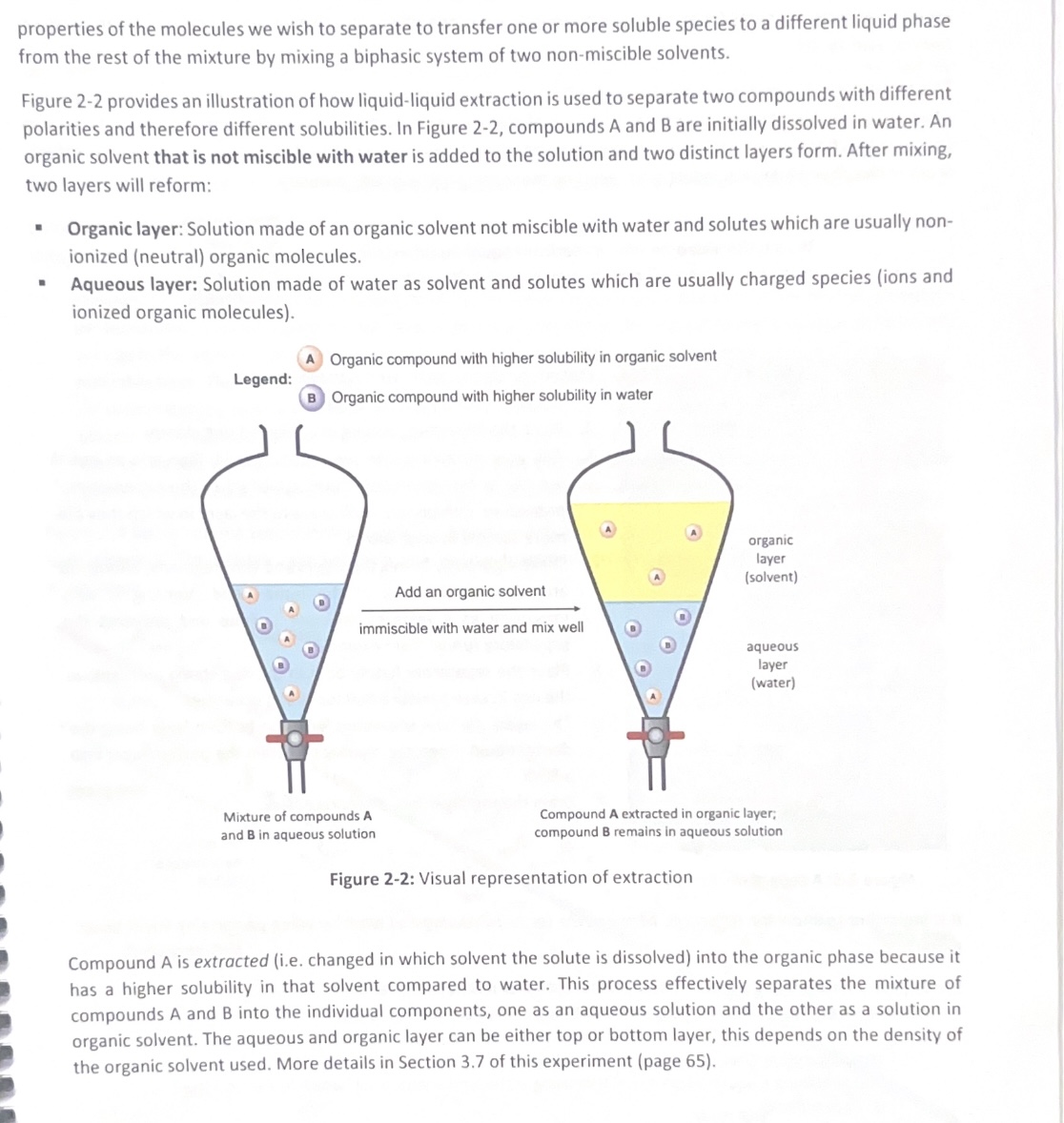
4.2 Probing Acid-Base Properties of pH-Sensitive Dyes with Liquid-Liquid Extraction Scen ario: You may have used pH indicators in previous chemistry experiments, but have you ever considered how they work? These are simply molecules (usually organic compounds!) whose color change depending on the pH of the solution in which they are dissolved. In this experiment, you will receive a sample of either Sudan Orange G or Neutral Red in an aqueous solution. The PH of the solution was chosen to form the salt (ionized) form of the pH indicator molecule. In the pre-lab, you will be asked at which pH each molecule becomes water-soluble. Look at the molecules below and identify which functional group(s) would act as either ionizable acid or ionizable base and review Figures 2-4 and 2-5 to see which PH allows for their dissolution in an aqueous layer. Ly N ~ N a DTD Sudan Orange G Neutral Red Figure 2-8: Structures of the two potential pH indicators used in Experiment 2 You will dispense 10 mL of the aqueous solution (the bottles will have a bottle-top dispenser already set to 10 mL) into a small beaker. Measure its pH and note the color of the solution for your worksheet then add the solution to your 60 mL separatory funnel. Understanding Checkpoint : To test the pH of a solution, simply dip the pH paper into the middle of the solution. Compare the color on the pH paper to the color on the chart to determine the pH of the solution. 'og True a False You will then add 10 mL of your chosen organic solvent: either dichloromethane or diethyl ether. Record your solvent choice on your worksheet. Your next task is to neutralize the molecule contained in the aqueous solution by choosing the appropriate reagent. In the laboratory, you will have access to 3 M HCl and 3 M NaOH. Add 10 mL of your chosen reagent to the separatory funnel, then cap, shake and vent the separatory funnel. Take the pH of your aqueous solution again and record your observations on your worksheet. Are you able to identify which of the two dyes you were given based on your experimentation? ***CAUTION*** | | Diethyl ether is VERY volatile, flammable, and explosive (liquid and vapours). ! Do not leave the solvent uncovered or use near the hot plate when heating. Both diethyl ether and dichloromethane must be handled inside the fume hood. | 75 Base PH 2 Draw the ionized form of Neutral Red. At what ph would this molecule form and be soluble in water? N. 3M HEF NaOH N NH, Acid PH 12 Draw the ionized form of Sudan Orange G. At what ph would this molecule form and be soluble in water? 3M MADIAHCI OH N N7. Indicate your choice of organic solvent and aqueous reagent below. Then complete the separatory funnel diagrams by labelling the aqueous and organic layer and indicating their color, Draw the indicator structure in its appropriate layer of the biphasic system. Use the correct protonation state of the molecule. [4 Points] Organic Solvent Aqueous Reagent After Adding Aqueous Reagent and Shaking After Adding Solvent 86 ma @ @& a@ & & & 2 #2 = Mixture of an ionizable acid Mixture of an ionizable acid Mixture of an ionizable Mixture of an ionizable and a non-ionizable and a non-ionizable base and a non-ionizable base and a non-ionizable compound in a biphasic compound in a biphasic compound in a biphasic compound in a biphasic mixture with an organic mixture with an organic mixture with an organic mixture with an organic solvent (top) and an acidic solvent (top) and a basic solvent (top) and an acidic solvent (top) and a basic (PH = 2) aqueous solution (PH = 12) aqueous solution (PH = 2) aqueous solution (PH = 12) aqueous solution (bottom) (bottom) bottom) (bottom lonizable acid, protonated (non- lonizable base, deprotonated (non- Legend: Non-ionizable charged) form charged) form compound Conjugate base of the ionizable acid ("salt of the acid") Conjugate acid of the ionizable base ( "salt of the base") Figure 2-5: Partition of organic molecules in biphasic systems Note: Functional groups being protonated/deprotonated on the ionizable acid or ionizable base and structures of non-ionizable compounds may vary. Compounds depicted in Figure 2-5 are simply common examples. In the above situations, we use strong acids and bases to ensure that the aqueous layer will be either very acidic (PH = 2) or basic (PH = 12) and ensure full conversion of the ionizable compounds into their salts to make them water-soluble. Aqueous solutions of near neutral pH (pH = 7) also have their utility in liquid-liquid extraction. For example, you may need to wash away inorganic salts formed as by-products of a reaction. We use dilute (generally 1 to 3 M) solutions of acids and bases for the extraction, as more concentrated solutions would be very corrosive and be unnecessarily dangerous when the separatory funnel is shaken. In general, the separation of molecules into the aqueous or organic layer is not perfect. For example, while a compound could have a preference for the organic layer, a small percentage could remain dissolved in the aqueous layer and vice versa. For this reason, extraction procedures often include multiple extraction with small volumes of solvent or aqueous solution to maximize the separation and recovery of compounds of interest. We can prove this by using an example of a theoretical compound A, which has a distribution coefficient (Ko) of 3properties of the molecules we wish to separate to transfer one or more soluble species to a different liquid phase from the rest of the mixture by mixing a biphasic system of two non-miscible solvents. Figure 2-2 provides an illustration of how liquid-liquid extraction is used to separate two com pounds with different polarities and therefore different solubilities. In Figure 2-2, compounds A and B are initially dissolved in water. An organic solvent that is not miscible with water is added to the solution and two distinct layers form. After mixing, two layers will reform: * Organic layer: Solution made of an organic solvent not miscible with water and solutes which are usually non- ionized (neutral) organic molecules. = Aqueous layer: Solution made of water as solvent and solutes which are usually charged species (ions and ionized organic molecules). \\A) Organic compound with higher solubility in organic solvent Legend: ) Organic compound with higher solubility in water organic layer i (solvent) Add an organic solvent immiscible with water and mix well aqueous layer (water) Mixture of compounds A Compound A extracted in organic layer; and B in aqueous solution compound B remains in aqueous solution Figure 2-2: Visual representation of extraction Compound A is extracted (i.e. changed in which solvent the solute is dissolved) into the organic phase because it has a higher solubility in that solvent compared to water. This process effectively separates the mixture of compounds A and B into the individual components, one as an aqueous solution and the other as a solution in organic solvent. The aqueous and organic layer can be either top or bottom layer, this depends on the density of the organic solvent used. More details in Section 3.7 of this experiment (page 65)
Step by Step Solution
There are 3 Steps involved in it
1 Expert Approved Answer
Step: 1 Unlock
Question Has Been Solved by an Expert!
Get step-by-step solutions from verified subject matter experts
Step: 2 Unlock
Step: 3 Unlock
Students Have Also Explored These Related Accounting Questions!









 Study Help