







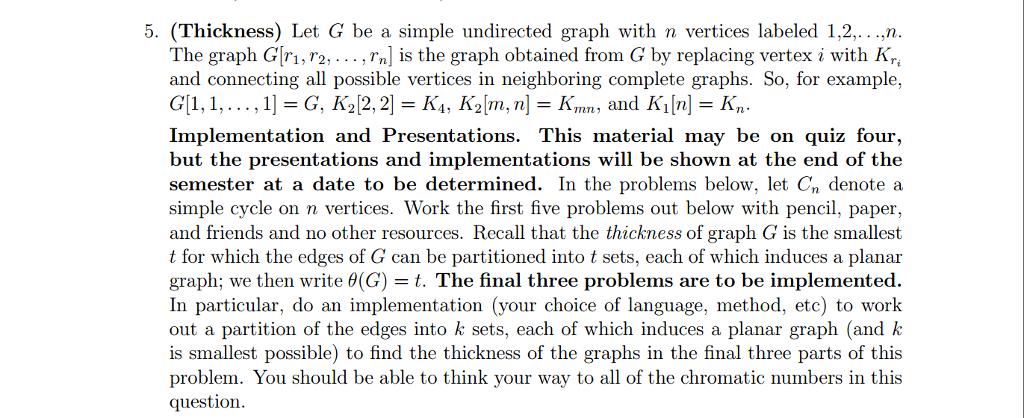
Question: 5. (Thickness) Let G be a simple undirected graph with n vertices labeled 1,2,.. .n The graph Glr, r2,...,rn] is the graph obtained from G
![vertices labeled 1,2,.. .n The graph Glr, r2,...,rn] is the graph obtained](https://dsd5zvtm8ll6.cloudfront.net/si.experts.images/questions/2024/09/66f4e2869c052_80666f4e286026b3.jpg)
5. (Thickness) Let G be a simple undirected graph with n vertices labeled 1,2,.. .n The graph Glr, r2,...,rn] is the graph obtained from G by replacing vertex i with K, and connecting all possible vertices in neighboring complete graphs. So, for example, GII, i, , 1] = G. K2 [2, 2]-K. Kalm, n] = Kmn, and Kiln] = Kn Implementation and Presentations. This material may be on quiz four, but the presentations and implementations will be shown at the end of the semester at a date to be determined. In the problems below, let Cn denote a simple cycle on n vertices. Work the first five problems out below with pencil, paper, and friends and no other resources. Recall that the thickness of graph G is the smallest t for which the edges of G can be partitioned into t sets, each of which induces a planar graph: we then write (G) t. The final three problems are to be implemented. In particular, do an implementation (your choice of language, method, etc) to work out a partition of the edges into k sets, each of which induces a planar graph (and k is smallest possible) to find the thickness of the graphs in the final three parts of this problem. You should be able to think your way to all of the chromatic numbers in this questionn 5. (Thickness) Let G be a simple undirected graph with n vertices labeled 1,2,.. .n The graph Glr, r2,...,rn] is the graph obtained from G by replacing vertex i with K, and connecting all possible vertices in neighboring complete graphs. So, for example, GII, i, , 1] = G. K2 [2, 2]-K. Kalm, n] = Kmn, and Kiln] = Kn Implementation and Presentations. This material may be on quiz four, but the presentations and implementations will be shown at the end of the semester at a date to be determined. In the problems below, let Cn denote a simple cycle on n vertices. Work the first five problems out below with pencil, paper, and friends and no other resources. Recall that the thickness of graph G is the smallest t for which the edges of G can be partitioned into t sets, each of which induces a planar graph: we then write (G) t. The final three problems are to be implemented. In particular, do an implementation (your choice of language, method, etc) to work out a partition of the edges into k sets, each of which induces a planar graph (and k is smallest possible) to find the thickness of the graphs in the final three parts of this problem. You should be able to think your way to all of the chromatic numbers in this questionn
Step by Step Solution
There are 3 Steps involved in it

Get step-by-step solutions from verified subject matter experts
 Study Help