





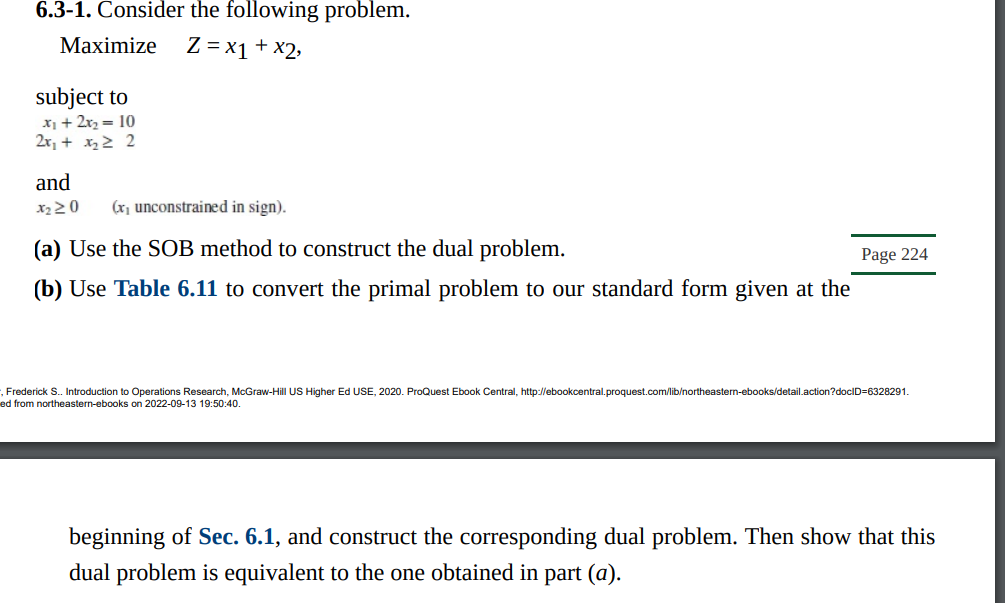
Question: 6.3-1. Consider the following problem. Maximize Z = x1 + x2, subject to *1 + 2x2 = 10 2x1 + *22 2 and x2 20
6.3-1. Consider the following problem. Maximize Z6.3-1. Consider the following problem. Maximize Z
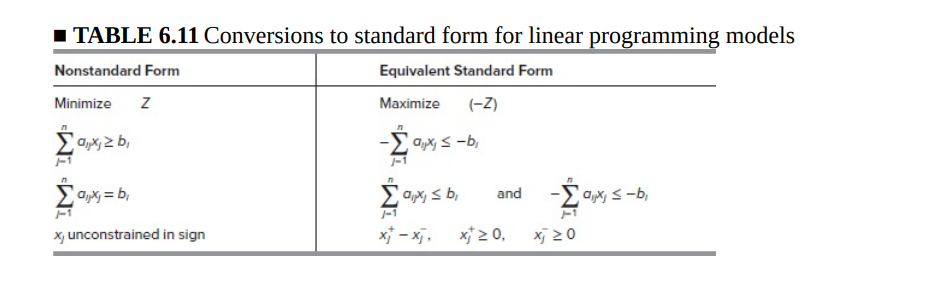
6.3-1. Consider the following problem. Maximize Z = x1 + x2, subject to *1 + 2x2 = 10 2x1 + *22 2 and x2 20 (, unconstrained in sign). (a) Use the SOB method to construct the dual problem. Page 224 (b) Use Table 6.11 to convert the primal problem to our standard form given at the Frederick S.. Introduction to Operations Research, McGraw-Hill US Higher Ed USE, 2020. ProQuest Ebook Central, http:/ebookcentral.proquest.com/libortheastern-ebooks/detail.action?docID=6328291. ed from northeastern-ebooks on 2022-09-13 19:50:40. beginning of Sec. 6.1, and construct the corresponding dual problem. Then show that this dual problem is equivalent to the one obtained in part (a).TABLE 6.11 Conversions to standard form for linear programming models Nonstandard Form Equivalent Standard Form Minimize Z Maximize (-Z) Sax, 2b, -I amx, s - b, Sap, = b, Cap, sb, and Cam, s-b, 1-1 x unconstrained in sign x - x 1 . x 20, x 20

Step by Step Solution

There are 3 Steps involved in it

1 Expert Approved Answer
Step: 1 Unlock blur-text-image
Question Has Been Solved by an Expert!

Get step-by-step solutions from verified subject matter experts

Step: 2 Unlock
Step: 3 Unlock

Students Have Also Explored These Related Mathematics Questions!