







Question: (8) (sim. to but not exactly Schroeder 2.21). Consider the multiplicity of two ideal gases A and B that share a common volume V and
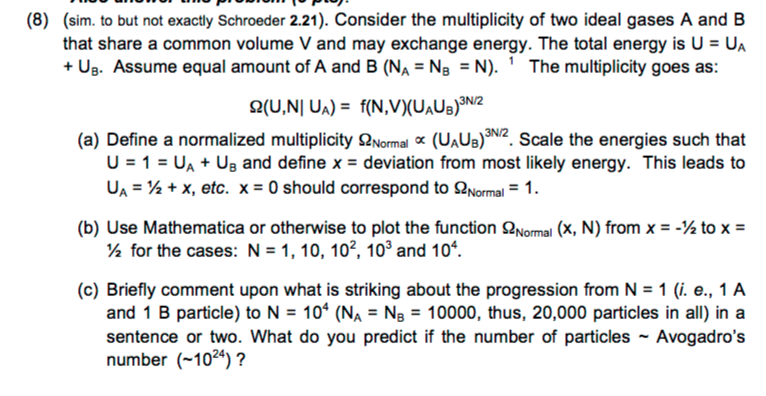
(8) (sim. to but not exactly Schroeder 2.21). Consider the multiplicity of two ideal gases A and B that share a common volume V and may exchange energy. The total energy is U UA UB. Assume equal amount of A and B (NA Na N). The multiplicity goes as (a) Define a normalized multiplicity S2Normal (UAUB)3N2. Scale the energies such that U = 1 = UA + UB and define x = deviation from most likely energy. This leads to = + x, etc. x = 0 should correspond to Normal 1. (b) Use Mathematica or otherwise to plot the function mal (x, N) from x =- to x = for the cases: N = 1, 10, 102, 103 and 104 (c) Briefly comment upon what is striking about the progression from N = 1 (i.e., 1 A and 1 B particle) to N = 104 (NA-NB-10000, thus, 20,000 particles in all) in a sentence or two. What do you predict if the number of particles Avogadro's number (-102) (8) (sim. to but not exactly Schroeder 2.21). Consider the multiplicity of two ideal gases A and B that share a common volume V and may exchange energy. The total energy is U UA UB. Assume equal amount of A and B (NA Na N). The multiplicity goes as (a) Define a normalized multiplicity S2Normal (UAUB)3N2. Scale the energies such that U = 1 = UA + UB and define x = deviation from most likely energy. This leads to = + x, etc. x = 0 should correspond to Normal 1. (b) Use Mathematica or otherwise to plot the function mal (x, N) from x =- to x = for the cases: N = 1, 10, 102, 103 and 104 (c) Briefly comment upon what is striking about the progression from N = 1 (i.e., 1 A and 1 B particle) to N = 104 (NA-NB-10000, thus, 20,000 particles in all) in a sentence or two. What do you predict if the number of particles Avogadro's number (-102)
Step by Step Solution
There are 3 Steps involved in it

Get step-by-step solutions from verified subject matter experts
 Study Help