







Question: 9. Consider the following workload a. Show the schedule using shortest remaining time, preemptive priority (a smaller priority number implies higher priority) and round robin
9. Consider the following workload
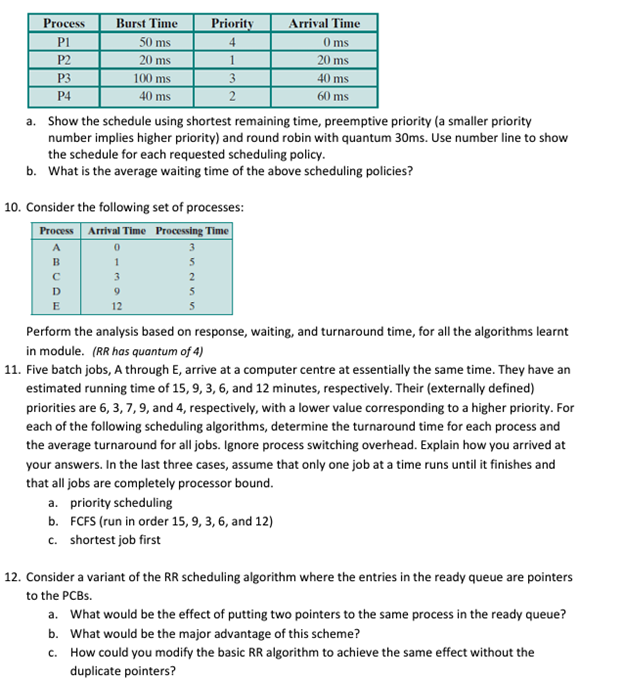
a. Show the schedule using shortest remaining time, preemptive priority (a smaller priority number implies higher priority) and round robin with quantum 30ms. Use number line to show the schedule for each requested scheduling policy. b. What is the average waiting time of the above scheduling policies? 10. Consider the following set of processes: Perform the analysis based on response, waiting, and turnaround time, for all the algorithms learnt in module. (RR has quantum of 4) 11. Five batch jobs, A through E, arrive at a computer centre at essentially the same time. They have an estimated running time of 15,9,3,6, and 12 minutes, respectively. Their (externally defined) priorities are 6,3,7,9, and 4 , respectively, with a lower value corresponding to a higher priority. For each of the following scheduling algorithms, determine the turnaround time for each process and the average turnaround for all jobs. Ignore process switching overhead. Explain how you arrived at your answers. In the last three cases, assume that only one job at a time runs until it finishes and that all jobs are completely processor bound. a. priority scheduling b. FCFS (run in order 15,9,3,6, and 12) c. shortest job first 12. Consider a variant of the RR scheduling algorithm where the entries in the ready queue are pointers to the PCBs. a. What would be the effect of putting two pointers to the same process in the ready queue? b. What would be the major advantage of this scheme? c. How could you modify the basic RR algorithm to achieve the same effect without the duplicate pointers
Step by Step Solution
There are 3 Steps involved in it

Get step-by-step solutions from verified subject matter experts
 Study Help