







Question: A block is attached to a horizontal spring and it slides back and forth in simple harmonic motion on a frictionless horizontal surface. At one
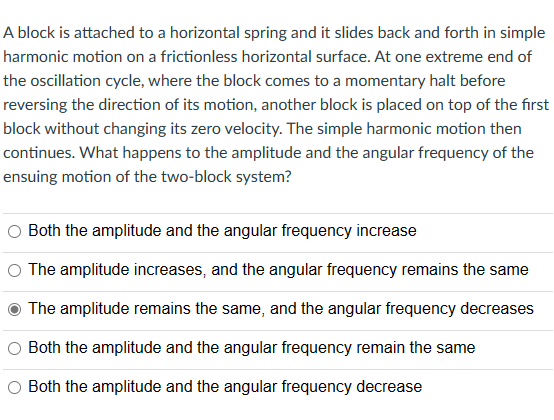
A block is attached to a horizontal spring and it slides back and forth in simple harmonic motion on a frictionless horizontal surface. At one extreme end of the oscillation cycle, where the block comes to a momentary halt before reversing the direction of its motion, another block is placed on top of the first block without changing its zero velocity. The simple harmonic motion then continues. What happens to the amplitude and the angular frequency of the ensuing motion of the two-block system? O Both the amplitude and the angular frequency increase O The amplitude increases, and the angular frequency remains the same O The amplitude remains the same, and the angular frequency decreases O Both the amplitude and the angular frequency remain the same O Both the amplitude and the angular frequency decrease
Step by Step Solution
There are 3 Steps involved in it

Get step-by-step solutions from verified subject matter experts
 Study Help