







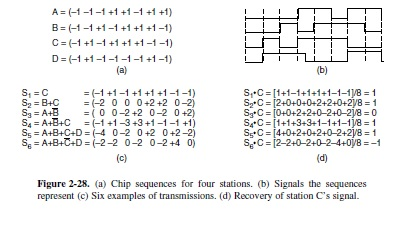
Question: A CDMA receiver gets the following chips: (-1 +1 -3 +1 -1 -3 +1 +1). Assuming the chip sequences defined in Fig. 2-28(a), which stations
A CDMA receiver gets the following chips: (-1 +1 -3 +1 -1 -3 +1 +1). Assuming
the chip sequences defined in Fig. 2-28(a), which stations transmitted, and which bits
did each one send? Write a program that can solve this problem using C.
PLEASE TYPE ANSWER DO NOT HAND WRITE. THANK YOU.
C H1+1-1++1-1-1) D H1+1-11-11+1-1) s,-c S B+- S-A-B 9, = ?-?-? = (-1+1-3-3 +1-1-1 +1 ) S A+B+C+D (-4 0-2 0+2 0+2-2 Sg=A+B+C+D = (-2-2 0-2 0-24 0) s,C [1+1-1+1+1+1-1-1V8-1 Src-I2+0+0+0+2+2+0+2/8-1 S3C [0+-0+2+2+0-2+0-218 0 S C [1+1+3+3+1-1+1-1/81 =(-2 -(0 0 0 0+2+2 0-2+2 0-2 0-2) 0+2) Sg. C = 2-2+0-2+0-2-4+0y8--1 Figure 2-28. (a) Chip sequences for four stations. (b) Signals the sequences represent (c) Six examples of transmissions. (d) Recovery of station C's signal. C H1+1-1++1-1-1) D H1+1-11-11+1-1) s,-c S B+- S-A-B 9, = ?-?-? = (-1+1-3-3 +1-1-1 +1 ) S A+B+C+D (-4 0-2 0+2 0+2-2 Sg=A+B+C+D = (-2-2 0-2 0-24 0) s,C [1+1-1+1+1+1-1-1V8-1 Src-I2+0+0+0+2+2+0+2/8-1 S3C [0+-0+2+2+0-2+0-218 0 S C [1+1+3+3+1-1+1-1/81 =(-2 -(0 0 0 0+2+2 0-2+2 0-2 0-2) 0+2) Sg. C = 2-2+0-2+0-2-4+0y8--1 Figure 2-28. (a) Chip sequences for four stations. (b) Signals the sequences represent (c) Six examples of transmissions. (d) Recovery of station C's signal
Step by Step Solution
There are 3 Steps involved in it

Get step-by-step solutions from verified subject matter experts
 Study Help