







Question: A poled piezoelectric cylinder made using PZT-DOD type I material, of 5-mm diameter and 12-mm height, is subjected to a force of 700 N.
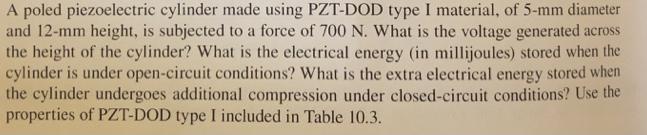
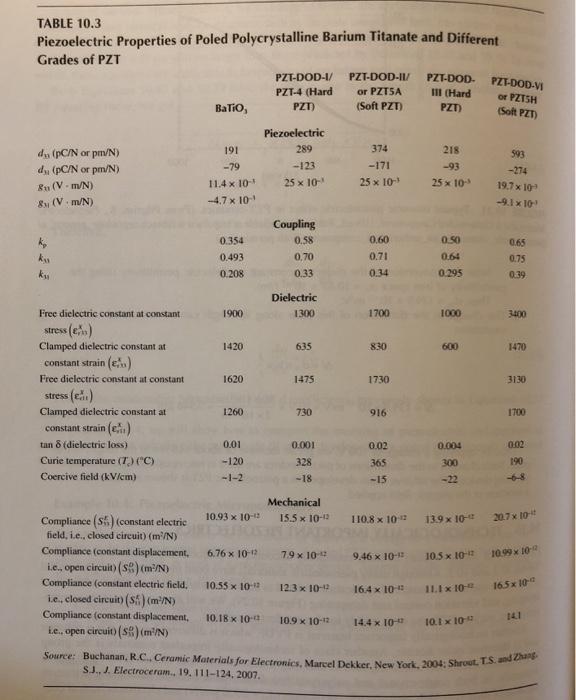
A poled piezoelectric cylinder made using PZT-DOD type I material, of 5-mm diameter and 12-mm height, is subjected to a force of 700 N. What is the voltage generated across the height of the cylinder? What is the electrical energy (in millijoules) stored when the cylinder is under open-circuit conditions? What is the extra electrical energy stored when the cylinder undergoes additional compression under closed-circuit conditions? Use the properties of PZT-DOD type I included in Table 10.3. TABLE 10.3 Piezoelectric Properties of Poled Polycrystalline Barium Titanate and Different Grades of PZT du (pC/N or pm/N) dy (pC/N or pm/N) Bu (V-m/N) 8 (V-m/N) k kys ks Free dielectric constant at constant stress (es) Clamped dielectric constant at constant strain (e) Free dielectric constant at constant stress (ed.) Clamped dielectric constant at constant strain (e) tan 8 (dielectric loss) Curie temperature (T) (C) Coercive field (kV/cm) Compliance (S) (constant electric field, i.e., closed circuit) (m/N) Compliance (constant displacement, i.e., open circuit) (S) (m/N) Compliance (constant electric field. i.e. closed circuit) (S) (m/N) Compliance (constant displacement, Le.. open circuit) (S) (m/N) BaTiO, 191 -79 11.4 x 10- -4.7 x 10- 0.354 0.493 0.208 1900 1420 1620 1260 0.01 -120 -1-2 10.93 x 10⁻² 6.76 x 10⁻¹² 10.55 x 10⁻¹² 10.18 x 10- PZT-DOD-1/ PZT-4 (Hard PZT) Piezoelectric 289 -123 25 x 10- Coupling 0.58 0,70 0.33 Dielectric 1300 635 1475 730 0.001 328 -18 Mechanical 15.5 x 10⁻¹² 7.9 x 10⁻² 12.3 x 10⁻² 10.9 x 10⁻² PZT-DOD-II/ or PZTSA (Soft PZT) 374 -171 25 x 10- 0,60 0.71 0.34 1700 830 1730 916 0.02 365 -15 110.8 x 10⁻² 9.46 x 10⁻¹² 16.4 x 10⁻² 14.4 x 10- PZT-DOD- III (Hard PZT) 218 -93 25 x 10-5 0.50 0.64 0.295 1000 600 0.004 300 -22 13.9 x 10⁻² 10.5 x 10⁻² 11.1 x 10- 10.1 x 10⁻¹² PZT-DOD-VI or PZTSH (Soft PZT) 593 -274 19.7 x 10 -9.1 x 10 0.65 0.75 0.39 3400 1470 3130 1700 0.02 190 20.7 x 10- 10.99 10-0 16.5 x 10-0 14.1 Source: Buchanan, R.C., Ceramic Materials for Electronics, Marcel Dekker, New York, 2004; Shrout, T.S. and Zhang S.J., J. Electroceram., 19, 111-124, 2007.
Step by Step Solution
There are 3 Steps involved in it
To find the voltage generated across the height of the cylinder we can use the formula for the piezoelectric effect V dF Where V is the voltage genera... View full answer

Get step-by-step solutions from verified subject matter experts
 Study Help